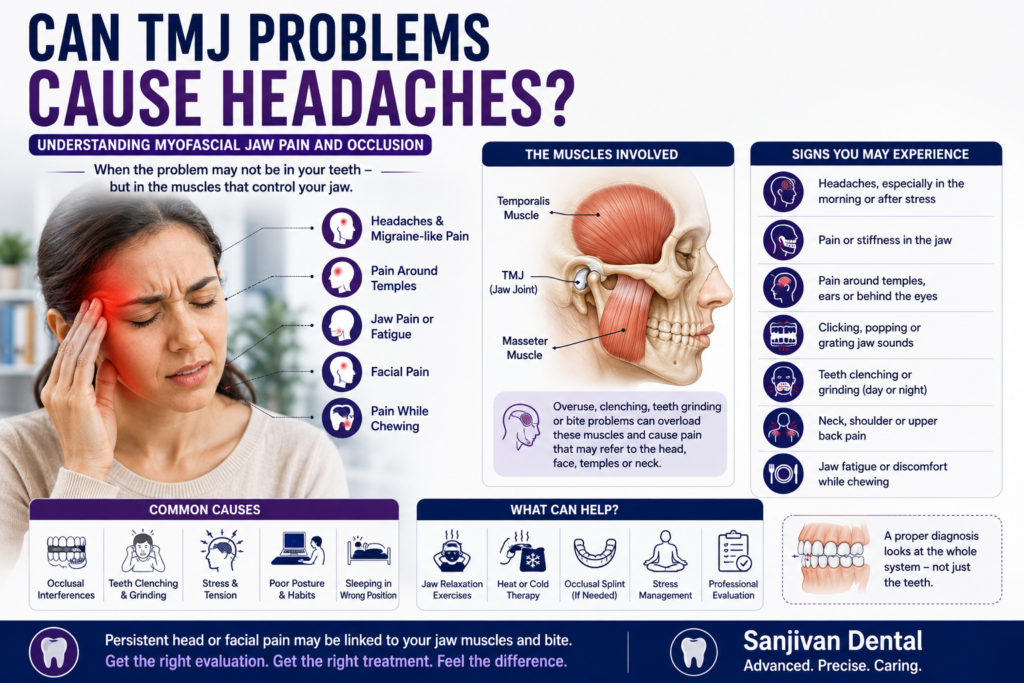
When the problem may not be in your teeth — but in the muscles that control your jaw
“Doctor, I have been having headaches for months. I have done all the tests, but nobody is able to find the reason.”
This is a type of patient often seen in dental practice.
These patients usually don’t come because of a toothache. They may come with headaches, facial pain, pain around the temples, jaw fatigue, or migraine-like pain.
Many may have already visited physicians and specialists and undergone investigations such as blood tests or MRI scans. Sometimes, these investigations appear normal, yet the pain continues.
During a detailed dental examination, however, something different may sometimes be found.
The teeth may not be painful. There may be no obvious cavity or dental infection, and the temporomandibular joint itself may not show a significant problem.
Instead, examination of the bite, jaw movements and chewing muscles may reveal muscle tenderness and fatigue. In selected patients, the problem may be related to the masticatory muscles and the way the jaw is functioning.
This type of problem is often described as myofascial pain or masticatory muscle pain and falls under the broader group of temporomandibular disorders (TMD).
Not Every “TMJ Problem” Is Actually a Joint Problem
The term “TMJ problem” is often used very broadly.
TMJ stands for temporomandibular joint, the joint that connects the lower jaw to the skull.
However, TMD (temporomandibular disorders) is a much broader term. A problem can involve:
- The jaw joint
- The muscles that move the jaw
- The surrounding tissues
- A combination of these
Some patients genuinely have problems inside the joint, while others have predominantly muscle-related pain.
A patient may come saying:
“Doctor, I think I have a TMJ problem.”
But after examination, the joint itself may not be the main source of the pain. Instead, the muscles responsible for chewing may be extremely tender.
The Muscles That Work Every Time You Chew
Think about how much work your jaw muscles perform every day.
You use them when you:
- Eat
- Chew
- Speak
- Swallow
- Clench your teeth
- Grind your teeth
- Hold your jaw in a particular position
Unlike a muscle in your arm or leg, these muscles may be active throughout much of the day.
Some people also clench their teeth without realizing it. This may happen:
- While concentrating at work
- While driving
- During exercise
- During stressful situations
- While sleeping
Over time, this can place considerable load on the masticatory muscles.
When these muscles become overloaded, they can become painful and tender. The pain may not always be felt exactly where the muscle is located. This is one reason why patients may experience pain in the temples, face or head, even though the source may be the muscles around the jaw.
“But Doctor, My Teeth Don’t Hurt”
This is something patients frequently say, and it can actually be an important clue.
A patient may have:
- No toothache
- No obvious cavity
- No dental infection
- No sensitivity
Yet examination of the chewing muscles may reveal significant tenderness.
For example, gentle examination of the masseter or temporalis muscles may reproduce the same pain that the patient has been experiencing.
This can change the direction of the investigation.
Instead of looking only at the teeth, the dentist may need to consider the entire chewing system.
Where Does Occlusion Come Into the Picture?
Occlusion simply means the way your upper and lower teeth come together.
Ideally, the teeth should work together in a coordinated manner when you close your mouth and move your jaw.
However, not every unusual bite causes pain.
Having an imperfect bite does not automatically mean that you will develop TMD. However, in selected patients with a clear clinical pattern of muscle pain and functional problems, particular contacts or interferences may appear to contribute to the way the jaw muscles are functioning.
The important relationship to understand is:
TEETH → JAW MOVEMENT → MUSCLES → SYMPTOMS
What Do We Look for During a TMD Examination?
When a patient presents with unexplained facial or head pain, the examination should not focus only on the teeth.
The entire system may need to be assessed, including:
- How the teeth meet
- Mandibular movements
- Premature contacts or interferences
- Muscle tenderness
- Masseter muscles
- Temporalis muscles
- Jaw opening
- Deviation during opening
- Joint sounds
- Joint tenderness
- Clenching habits
- Grinding habits
- The patient’s pain history
An important question during examination is:
Can the patient’s familiar pain be reproduced by examining the jaw muscles?
This can provide valuable clinical information.
A proper TMD evaluation may consider the head, neck, face and jaw, including tenderness and movement abnormalities. Imaging may be useful in selected cases when it can help establish a diagnosis.
What If Every Test Is Normal but the Pain Continues?
This can be one of the most frustrating situations for patients.
They may have been told:
- “Your MRI is normal.”
- “Your scan is normal.”
- “Your blood tests are normal.”
Yet the pain continues.
A normal scan does not mean that the patient’s pain isn’t real.
Muscle-related pain cannot always be diagnosed simply by looking at an MRI or CT scan. This is where a detailed clinical examination becomes particularly important.
A patient’s history and physical examination can reveal findings that a scan may not show.
What Is Myofascial Pain Dysfunction Syndrome?
The term Myofascial Pain Dysfunction Syndrome (MPDS) has historically been used to describe a pattern of pain involving the muscles and fascia, particularly the muscles involved in chewing.
Today, clinicians may use more specific terms such as myalgia or myofascial pain associated with TMD.
The important point for patients is simple:
The pain can come from the muscles rather than from the jaw joint itself.
The muscles may become tender, fatigued and painful. Sometimes, the pain can also be felt away from the actual muscle. This is known as referred pain.
Why Can Jaw Muscle Pain Be Felt in the Head?
The muscles of mastication are closely connected through the nervous system with other structures in the head and face.
When these muscles become painful, the brain may interpret some of that pain in nearby regions.
Patients may experience discomfort around:
- Temples
- Forehead
- Cheek
- Jaw
- Ear region
- Side of the head
TMD-associated headache is recognized clinically. However, not every headache or migraine is caused by TMD.
Headaches and migraines have many possible causes and may require appropriate medical evaluation.
What About Patients Who Have Been Suffering for Months?
Over the years, some patients may present with persistent head or facial pain even though their dental examination does not show an obvious tooth-related cause.
In carefully selected cases, examination may reveal:
- Significant tenderness of the chewing muscles
- Functional occlusal contacts
- An abnormal pattern of mandibular function
After diagnosis and appropriate treatment planning, addressing the functional relationship between the teeth and jaw may sometimes improve muscle tenderness, jaw comfort and associated symptoms.
However, this should not be interpreted as a claim that correcting the bite cures every headache or every TMD.
The clinical approach applies to specific patients in whom examination suggests that occlusal and muscular factors are genuinely relevant.
Can Changing the Bite Be Dangerous?
Yes, if it is done indiscriminately.
Grinding healthy teeth, placing extensive crowns or performing irreversible dental procedures simply because someone says, “Your bite is causing your TMJ,” should not be taken lightly.
Not every patient with TMD needs permanent changes to their teeth or bite.
The approach should therefore be:
History → Examination → Diagnosis → Conservative Management Where Appropriate → Carefully Selected Treatment
If an irreversible procedure is being considered, the patient should understand why it is being recommended and what alternatives are available.
What Can Be Done for Muscular TMD?
Treatment depends on the diagnosis.
For many patients, the initial approach may be relatively simple.
Treatment may include:
- Awareness and reduction of clenching
- Jaw exercises
- Stretching
- Physiotherapy
- Heat or cold therapy
- Stress and habit management
- Appropriate medication when indicated
- A suitable oral appliance in selected cases
Not every patient needs every treatment, and not every patient needs a dental procedure.
When Should You Consider a Dental Evaluation?
If you have persistent headaches or facial pain and have already been investigated for other causes, it may be worth discussing a TMD assessment with a dentist experienced in jaw disorders and occlusion.
This may be particularly relevant if you also notice:
- Jaw fatigue
- Facial muscle tenderness
- Pain while chewing
- Morning jaw discomfort
- Clenching or grinding
- Temple pain
- Pain around the ear without an obvious ear problem
- Jaw stiffness
- Difficulty opening the mouth
- Pain that seems to originate around the jaw
However, patients should not stop seeing their physician or neurologist simply because they suspect a dental cause.
Headaches have many possible causes.
A dental evaluation should complement appropriate medical assessment, not replace it.
A Message to Patients Who Are Still Searching for an Answer
If you have been suffering from headaches or facial pain for months, undergone multiple investigations and still haven’t found an explanation, it can be extremely frustrating.
Sometimes the answer isn’t where we initially expect it to be.
The teeth may be healthy.
The MRI may be normal.
The blood tests may be normal.
And yet the muscles involved in chewing may be extremely tender and overloaded.
That is why a careful examination of the jaw, muscles, occlusion and mandibular function can sometimes provide an important missing piece of the puzzle.
It doesn’t mean that every headache comes from the jaw.
It doesn’t mean that every patient needs their bite changed.
It means that the masticatory system deserves to be examined when the symptoms and clinical findings point in that direction.
Final Thoughts from Dr. Durgaprasad Hiwale
One of the most rewarding things about dentistry is realizing that sometimes a patient’s complaint isn’t actually coming from the tooth they think is responsible.
Over the years, patients may present with unexplained head, facial or jaw pain. In some carefully selected cases, the teeth themselves are not the problem—the muscles may be.
The key is proper diagnosis.
Don’t assume every headache is a TMJ problem.
Don’t assume every clicking jaw needs treatment.
And don’t allow anyone to permanently alter your teeth or bite without a clear diagnosis, an explanation of alternatives and an understanding of the risks.
Sometimes the most important step isn’t doing more tests.
It is having the right person examine the right system.