“Doctor, do I really need a root canal?”
I hear this question quite often.
Sometimes a patient comes to the clinic because a tooth has been hurting for several days. Sometimes they have been taking painkillers and hoping it will settle down. And sometimes they tell me something that can be misleading:
“Doctor, it doesn’t hurt anymore.”
A tooth problem doesn’t always follow a predictable pattern. A tooth can hurt terribly one day and feel almost normal a few days later. In some cases, the nerve inside the tooth may already be severely damaged even though the pain has reduced.
Severe toothache can also be extremely distressing and may even keep patients awake at night.
But does every painful tooth need a root canal?
No.
And does every tooth that needs a root canal cause pain?
Again, no.
That’s why the diagnosis is more important than the pain alone.
What Happens Inside a Tooth?
To understand why a root canal may be necessary, it helps to understand what is happening inside the tooth.
Under the hard outer layers of a tooth is a soft tissue called the pulp. It contains nerves and blood vessels.
When a cavity becomes very deep, a tooth cracks, there is significant trauma, or a tooth undergoes repeated dental procedures, the pulp can become inflamed or infected.
In the early stages, the tooth may simply be sensitive. But if the damage becomes irreversible, the pulp may no longer be capable of recovering.
That’s when root canal treatment may be needed.
The purpose of root canal treatment isn’t simply to “remove the nerve.”
The goal is to:
- Remove diseased tissue
- Clean and disinfect the root canal system
- Properly seal the canals
- Preserve the natural tooth
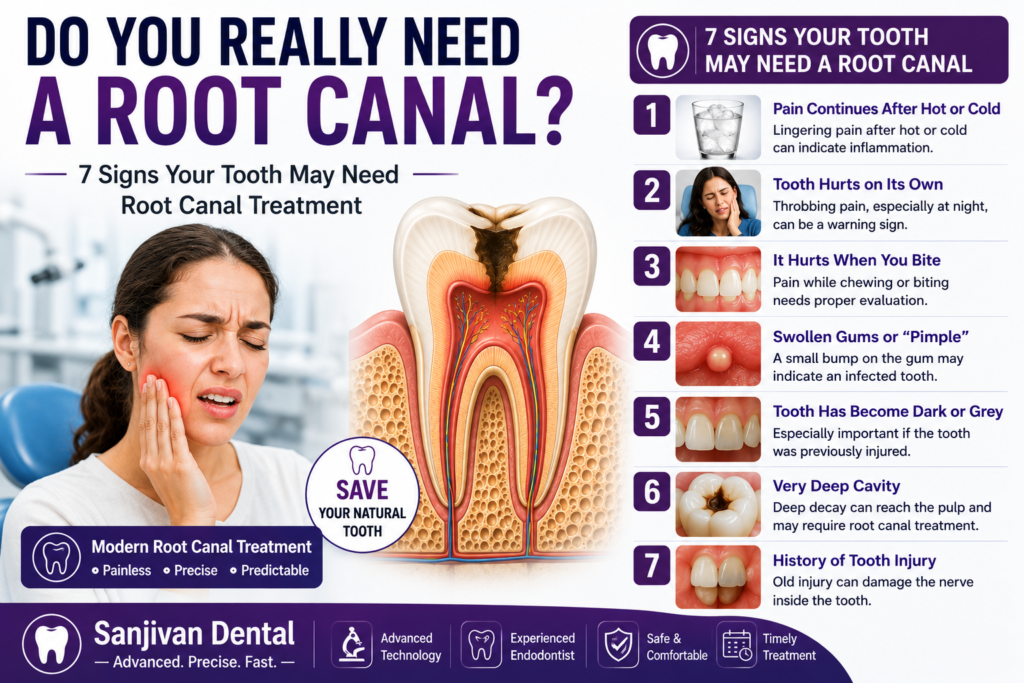
7 Signs Your Tooth May Need a Root Canal
1. Pain Continues After Hot or Cold
A little sensitivity when you drink something cold isn’t necessarily a root canal problem.
What is more concerning is lingering pain.
For example, you drink tea or coffee and the tooth hurts. You stop drinking, but instead of settling quickly, the pain continues for quite some time.
This can indicate significant inflammation of the pulp.
2. The Tooth Starts Hurting on Its Own
This is different from a tooth that hurts only when you bite into something.
A patient may be sitting quietly, doing nothing, and suddenly the tooth begins throbbing.
Sometimes the pain becomes worse at night.
In severe cases, the pain can be so intense that the patient cannot sleep properly for hours.
However, root canal treatment should not be decided based on pain alone. The dentist must identify exactly where the pain is coming from and what is happening inside the tooth.
3. It Hurts When You Bite
A tooth that hurts when you bite or chew needs examination.
The problem could be related to inflammation around the root, but it could also be caused by:
- A cracked tooth
- A high filling
- Trauma
- Another dental problem
The same symptom can have several different causes, which is why proper diagnosis is important.
4. Your Gum Is Swollen or You Notice a Small “Pimple”
Some patients notice a small swelling on the gum and assume it is just a minor gum problem.
Sometimes, however, it may be related to an infected tooth.
You may notice a small bump that occasionally drains and then disappears. The tooth may not even hurt very much at this stage.
This does not necessarily mean that the infection has disappeared. It may simply mean that the infection has found a way to drain.
5. The Tooth Has Become Dark or Grey
A colour change is particularly important if the tooth has previously been injured.
A front tooth can be hit during a fall, accident, or sports injury and appear completely fine initially.
Months or even years later, the tooth may become darker.
A colour change does not automatically mean that the tooth needs a root canal, but it is something that should be investigated.
6. There Is a Very Deep Cavity
A small cavity is relatively straightforward to deal with.
But when decay is allowed to progress deep into the tooth, it can eventually reach the pulp.
At that point, a filling may no longer be enough.
Unfortunately, dental decay does not always cause pain while it is progressing.
7. You Have Had an Injury to the Tooth in the Past
If you’ve ever had a significant injury to a tooth, don’t ignore later changes.
The nerve and blood supply inside a tooth can be damaged following trauma.
Sometimes the problem becomes apparent immediately, while in other cases it may take much longer.
If an old injured tooth becomes painful, changes colour, or develops swelling around it, it deserves a proper examination.
Not Every Painful Tooth Needs a Root Canal
This is where many patients become confused.
Tooth pain can come from many different things.
For example:
- Sensitivity may be caused by exposed dentin or gum recession.
- Pain while biting may come from a crack.
- A filling that is slightly high can make a tooth uncomfortable.
- Sinus problems can sometimes make upper teeth feel painful.
So, if someone says, “Your tooth hurts, therefore you need a root canal,” that is an oversimplification.
A proper diagnosis should always come first.
Can a Tooth Need a Root Canal Without Causing Pain?
Yes.
This is one of the most important things for patients to understand.
Sometimes the pulp inside a tooth becomes severely damaged and eventually dies. The intense pain may then reduce or disappear.
The patient may think:
“Great, the tooth has settled.”
But the infection can continue around the root.
You may only discover the problem later because of gum swelling or something visible on an X-ray.
Therefore, absence of pain does not necessarily mean absence of disease.
How Do We Know Whether a Root Canal Is Necessary?
A proper dental examination is essential.
A root canal should not be diagnosed simply by asking whether the tooth hurts.
The dentist may consider several pieces of information, including:
- Patient history
- Clinical examination
- Pulp tests
- Pressure and other clinical tests
- Dental X-rays
- CBCT scan in selected complicated cases
By combining these findings, the dentist can determine whether the pulp is healthy, inflamed but potentially recoverable, irreversibly damaged, or infected.
The treatment should follow the diagnosis—not the other way around.
What If I Just Wait and See?
If the pain disappears, it can be tempting to delay a dental examination.
However, dental infections don’t always give you a warning before becoming more serious.
A tooth can sometimes remain relatively comfortable while infection progresses around the root.
The longer a damaged tooth is left untreated, the more complicated the situation can potentially become.
Does Every Root Canal Have to Be Done in One Visit?
Not necessarily.
Many suitable cases can be completed in a single visit, but single-visit treatment isn’t appropriate simply because a patient wants it finished quickly.
The condition of the tooth, infection, anatomy of the canals, and other clinical factors must be considered.
The objective should always be:
Clean and treat the root canal properly—not merely complete it quickly.
Modern magnification, imaging, rotary instruments, and irrigation techniques can make root canal treatment more predictable in appropriate cases.
What Happens After the Root Canal?
Root canal treatment is not necessarily the end of treatment.
The tooth still needs to be restored properly.
The amount of restoration required depends on how much natural tooth structure remains and which tooth is involved.
A heavily damaged back tooth may require a crown or another protective restoration.
The long-term survival of the tooth depends not only on the root canal itself but also on how well the tooth is restored and maintained afterward.
When Should You Get a Tooth Checked?
Don’t wait until you are awake at 2 AM with severe tooth pain.
Get the tooth examined if you notice:
- Pain that keeps coming back
- Lingering sensitivity to hot or cold
- Spontaneous or throbbing pain
- Pain while biting
- Swelling near the tooth
- A gum boil or pimple
- A darkening tooth
- A deep cavity
- A previously injured tooth that has changed
Seek Urgent Care When Needed
If swelling spreads to the face or neck, or you develop difficulty swallowing or breathing, seek urgent dental or medical care.
The Most Important Thing to Remember
A root canal isn’t something that should be recommended simply because a tooth hurts.
And it shouldn’t be avoided simply because the tooth doesn’t hurt.
The important question is:
“What is actually happening inside and around that tooth?”
If the tooth can be saved predictably, preserving your natural tooth is often worth making the effort to do so.
If you’re worried that a root canal will be painful, talk to your dentist about your concerns before treatment. With modern dentistry, root canal treatment does not have to be the frightening experience that many people imagine.
If your tooth is keeping you awake at night, don’t keep fighting the pain with painkillers and hope it will disappear.
Find out what is causing it.
About the Author
Dr. Durgaprasad Hiwale
MDS Endodontics
Sanjivan Dental