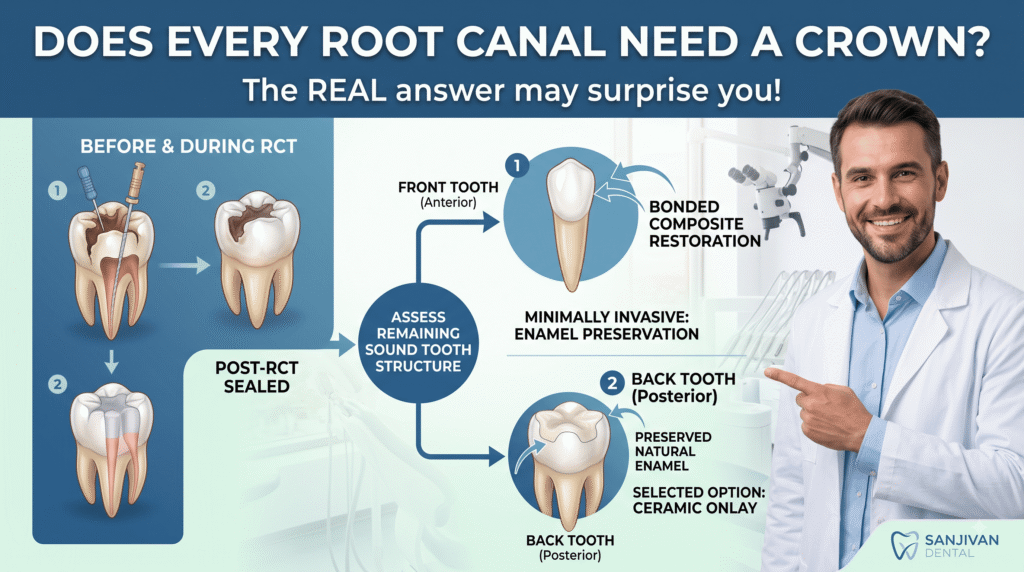
A common question patients ask after a root canal is:
“Doctor, now that the root canal is done, do I definitely need a crown?”
The answer is: Not necessarily.
At Sanjivan Dental, we don’t believe that every root-canal-treated tooth automatically needs a crown. Instead, we evaluate how much natural tooth structure has been lost because of decay, fracture, trauma, or previous restorations, and then decide what type of restoration will best protect the tooth.
Our philosophy is simple:
Preserve as much healthy natural tooth structure as possible while providing the protection the tooth actually needs.
Why Does a Tooth Sometimes Need Protection After a Root Canal?
A root canal treats the infected or inflamed pulp inside the tooth, but the procedure does not replace lost tooth structure. A tooth may have already lost substantial structure due to:
- Deep dental cavities
- Previous large restorations
- Trauma, cracks, or fractures
- Removal of weakened tooth structure during access and treatment
After completing the root canal, our primary clinical question is: How much sound tooth structure is left? That answer determines the ideal final restoration.
Does a Root Canal Automatically Make a Tooth Weak?
This is a common oversimplification. The structural strength of a tooth depends mainly on how much sound hard tissue has been destroyed, not simply on the fact that an endodontic procedure was performed.
We do not follow a rigid rule of “Root Canal = Automatic Full Crown.” Instead, we evaluate the mechanical and biological demands of each individual tooth.
Anterior vs. Posterior Teeth: Different Functional Demands
Anterior Teeth (Front Teeth)
- Front teeth experience mainly shearing forces rather than heavy crushing loads.
- If an anterior tooth has sufficient remaining structure and intact marginal ridges, a high-strength bonded composite restoration is often the treatment of choice.
- Preparing a full crown removes significant healthy enamel. In the aesthetic zone, preserving natural enamel margins and tooth structure is a major clinical priority whenever predictable.
Posterior Teeth (Back Teeth)
- Molars and premolars endure heavy vertical and lateral forces during chewing.
- When deep decay, cracked cusps, or large cavity preparations have weakened the tooth walls, some form of cuspal or coronal coverage is necessary to prevent catastrophic splits.
- However, providing coverage does not always mean grinding the entire tooth down for a full crown.
Spectrum of Restorative Options: Beyond Just Fillings and Crowns
Modern adhesive dentistry provides minimally invasive alternatives that sit between a simple filling and a traditional full crown:
| Restorative Type | Clinical Indication | Tooth Preservation Benefit |
| Bonded Composite | Minimal structural loss with intact peripheral walls (common in anterior teeth). | Zero additional tooth preparation; preserves 100% of remaining healthy tissue. |
| Inlays | Localized internal loss without compromised cusps. | Replaces missing internal structure using durable ceramic or composite blocks. |
| Onlays / Overlays | Weakened or cracked posterior cusps needing cuspal protection. | Shields vulnerable chewing surfaces without trimming healthy circumferential walls. |
| Tabletop / Partial Coverage | Moderate structural loss needing occlusal reinforcement against heavy bite forces. | Evenly distributes biting stress while leaving natural enamel margins untouched. |
| Full Crowns | Severe loss of tooth structure, extensive breakdown, or advanced cracked tooth cases. | Provides complete 360-degree coronal stabilization and functional ferrule containment. |
Conservative Dentistry vs. Under-Restoring
Being conservative does not mean choosing the smallest restoration regardless of the clinical situation.
If a heavily compromised posterior tooth or a cracked molar genuinely requires cuspal protection, omitting it puts the tooth at risk of a non-restorable root fracture.
Our approach balances two critical principles:
- Never remove healthy tooth structure unnecessarily.
- Never compromise structural protection when the tooth genuinely needs it.
Frequently Asked Questions (FAQs)
Does every tooth need a crown after a root canal?
No. The requirement for a crown depends on the remaining tooth volume, tooth position, presence of crack lines, and functional bite forces.
Is a crown always required on a molar?
While molars frequently require cuspal protection due to high chewing loads, conservative options like ceramic onlays or tabletop overlays can often protect the tooth without full-coverage preparation.
Does an anterior root-canal-treated tooth need a crown?
No. If the tooth has sufficient natural structure and intact walls, a bonded composite restoration is often safer and more conservative than a full crown.
What happens if a cracked tooth is left unprotected?
A cracked posterior tooth subjected to daily chewing forces can develop propagating fracture lines, which may eventually split the root and necessitate extraction.
Are onlays durable alternatives to full crowns?
Yes. Modern adhesive bonding allows ceramic onlays to reinforce weakened cusps predictably while preserving significantly more natural tooth enamel than a conventional crown.
Our Approach at Sanjivan Dental
We don’t ask, “Does this root-canal-treated tooth need a crown?”
We ask:
“What does this specific tooth require to stay functional, protected, and healthy while saving as much natural tooth structure as possible?”
If you have questions about restoring a root-canal-treated tooth, schedule an appointment with Sanjivan Dental for a personalized, tooth-preserving evaluation.