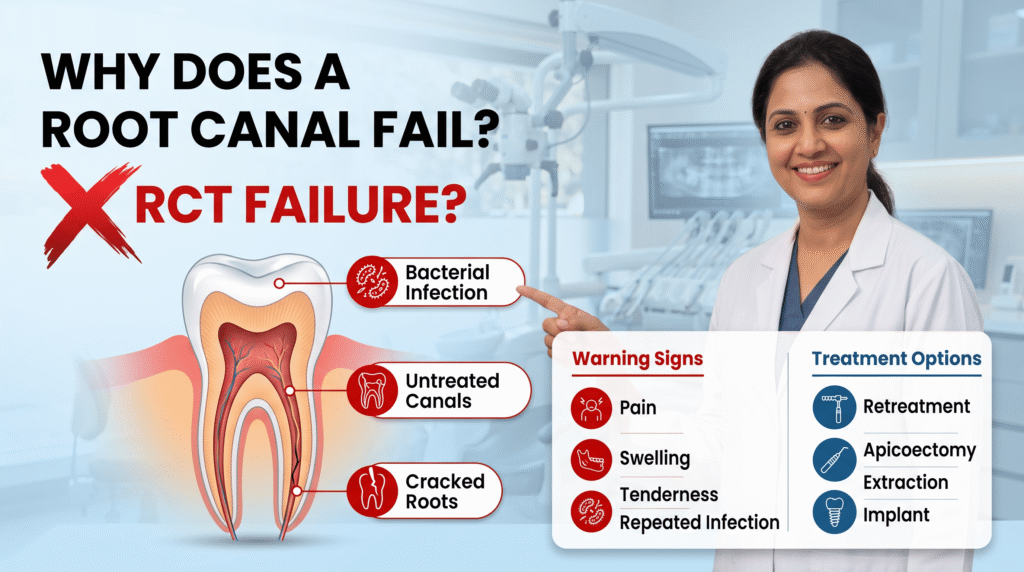
A patient often comes to our clinic asking:
“Doctor, I already had a root canal on this tooth. Why is it hurting again?”
It is a completely valid concern. A root canal-treated tooth can develop problems months or even years after treatment. When that happens, the solution is neither an automatic repeat of the root canal nor an immediate tooth extraction.
At Sanjivan Dental, our clinical approach starts with a fundamental question: Is this tooth still restorable, and can it be predictably saved?
What Does a “Failed Root Canal” Actually Mean?
Root canal treatment (RCT) has a high success rate when properly diagnosed, cleaned, and sealed. However, no dental treatment is immune to long-term biological changes.
A “failed” root canal does not necessarily mean poor previous work. It simply indicates that the tooth has developed an issue requiring intervention.
Common Causes of Root Canal Failure:
- Missed or Complex Canal Anatomy: Natural teeth often have curved, narrow, or extra canals that can harbor hidden bacteria.
- Persistent Infection: Microscopic bacteria surviving in inaccessible branches of the root canal system.
- Coronal Leakage & New Decay: An aging crown, broken filling, or new cavity that allows saliva and bacteria to seep back into the roots.
- Procedural or Iatrogenic Complications: Structural alterations or complications created during earlier access and instrumentation.
- Cracks and Vertical Root Fractures: Structural fractures extending below the gumline.
Important Note on Pain: Pain alone does not confirm that a root canal has failed. Mild temporary discomfort can be normal, but persistent pain, gum swelling, or a draining pimple (sinus tract) requires clinical and radiographic evaluation.
The Sanjivan Diagnostic Protocol
We believe true conservative dentistry does not mean “saving a tooth at any cost.” It means saving a tooth when it makes sound biological and structural sense.
Before recommending retreatment, we follow a strict four-step evaluation:
1. Restorability Assessment (First Priority)
There is no clinical value in performing a technically perfect root canal retreatment if the remaining tooth structure is too weak to support a long-term crown or restoration.
2. Forensic Analysis of Past Treatment
We evaluate the existing treatment to identify missed canals, persistent bacterial load, or iatrogenic changes—focusing strictly on what can realistically be corrected.
3. Advanced Magnification
Using dental operating microscopes and advanced imaging, we assess the internal canal anatomy to determine if retreatment is technically feasible.
4. Transparent Treatment Planning
We present a realistic prognosis, estimated longevity, procedure costs, and alternative options so you can make an informed decision.
Retreatment vs. Extraction: Which Option is Right?
| Parameter | Endodontic Retreatment | Tooth Extraction & Replacement |
| Primary Objective | Preserve the natural tooth structure | Remove the source of infection entirely |
| When Recommended | The tooth is structurally restorable and the cause of failure can be resolved | Non-restorable tooth, deep vertical fracture, or severe bone loss |
| Clinical Advantage | Preserves your natural jawbone and bite feel | Provides a predictable, permanent solution when saving the tooth is impossible |
| Follow-up Treatment | Core buildup and a protective crown | Dental implant, bridge, or partial prosthesis |
Frequently Asked Questions (FAQs)
Can a tooth get infected years after a successful root canal?
Yes. Over time, crowns can wear down, new decay can form at the margins, or fillings can leak, allowing bacteria to re-contaminate the canal system.
Is a root canal failure always the previous dentist’s fault?
No. Complex microscopic canal anatomy, biological resistance of certain bacteria, micro-cracks, and structural wear can cause complications without any procedural error.
Why must restorability be checked before retreatment?
Cleaning the root canal addresses the biological infection, but the outer tooth must have enough healthy enamel and dentin to hold a functional restoration long-term.
When is extraction the better choice?
Extraction is indicated when a tooth has a vertical root fracture, severe bone loss, or insufficient tooth structure remaining above the gumline to place a stable crown.
Our Philosophy at Sanjivan Dental
A failed root canal does not automatically mean the tooth must be pulled, nor does it mean it should blindly be retreated.
First understand the tooth. Understand what went wrong. Then decide what offers a predictable long-term outcome.