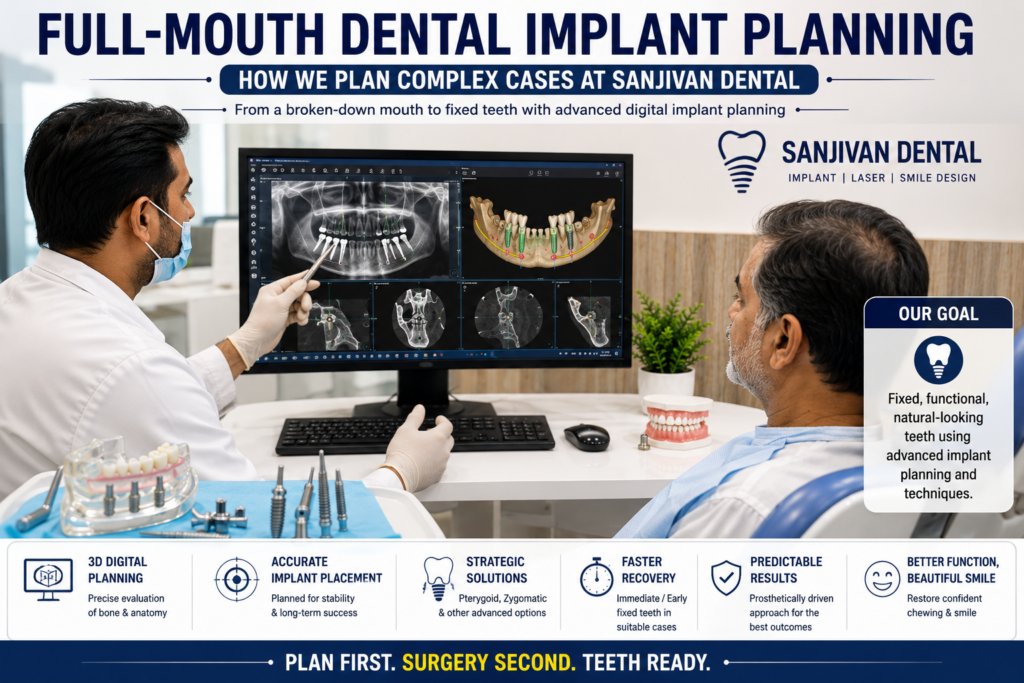
From a Broken-Down Mouth to Fixed Teeth: How Modern Digital Implant Planning Has Changed Full-Mouth Rehabilitation
When a patient has several broken, loose, or missing teeth, one of the biggest questions is:
“Doctor, can you actually give me fixed teeth?”
Many patients who come to us have already been told that their case is too complicated.
Some have very little bone. Some have severe gum disease. Some have mobile teeth. Some have been without teeth for years. Others have been told that they need extensive bone grafting before implants can even be considered.
And some patients have simply accepted that they will have to live with removable dentures.
But implant dentistry has changed considerably.
Today, with CBCT imaging, digital scanning, computer-based planning, and advanced implant techniques, many complex cases can be planned differently.
At Sanjivan Dental, our approach is not simply:
“Where can I put an implant?”
Our approach is:
“How can I reconstruct the patient’s entire chewing system in a predictable, functional, and long-lasting way?”
That requires planning the case before we place even a single implant.
The First Step Is Not the Implant
When a patient comes to us with multiple damaged or missing teeth, the first thing we do is not immediately start placing implants.
We first try to understand the entire mouth.
We look at:
- The remaining teeth
- Gum health
- Bone levels
- Existing infections
- Tooth mobility
- Occlusion
- Available bone
- Facial and smile characteristics
- Previous dental treatment
- The patient’s ability to chew
- The patient’s expectations
- General medical history
This comprehensive assessment is extremely important.
A full-mouth implant case is not simply a collection of individual implants. It is one complete rehabilitation.
Step 1: Checking for Active Periodontal Disease
One of the first things we look for is gum health.
This is particularly important when a patient has several mobile teeth or has lost multiple teeth because of periodontal disease.
We look for:
- Gum inflammation
- Bleeding
- Deep periodontal pockets
- Bone loss
- Mobile teeth
- Calculus
- Active infection
- Poor oral hygiene
- Remaining teeth with questionable prognosis
If active periodontal disease is present, it needs to be addressed.
Why?
Because placing implants into a mouth with uncontrolled infection and poor oral hygiene without first addressing the underlying problem is not good implant planning.
The patient also needs to understand that implants are not a replacement for oral hygiene. They require regular maintenance too.
So before we start planning the final teeth, we want to create a healthy foundation.
Step 2: Assessing Which Teeth Can Be Saved
Not every damaged tooth needs to be removed.
This is an important part of treatment planning.
We carefully assess the remaining teeth and classify them into different categories.
Some teeth may be:
- Restorable and worth saving
- Of questionable prognosis
- Beyond predictable restoration
This decision requires experience.
Saving a tooth simply because it is present is not always the right decision. On the other hand, removing teeth that could have been predictably treated is also not appropriate.
The objective is to create the best possible foundation for the final rehabilitation.
Step 3: CBCT Scanning
Once we understand the condition of the mouth, three-dimensional imaging becomes extremely valuable.
At Sanjivan Dental, we use CBCT imaging to evaluate the available bone in three dimensions.
A conventional dental X-ray provides a two-dimensional image, whereas CBCT provides much more information about the patient’s anatomy.
We can evaluate:
- Bone height
- Bone width
- Bone density characteristics
- Anatomical structures
- Sinus position
- Nasal floor
- Mental foramina
- Inferior alveolar nerve canal
- Existing pathology
- Available implant sites
This information helps us understand what is actually possible.
We Don’t Simply Look at How Much Bone Is Left
This is an important difference in advanced implant planning.
The question isn’t only:
“Where is there bone?”
The question is:
“Where is the right bone for placing an implant that will support the final teeth?”
Sometimes the available bone is not in the ideal position for conventional implants.
That’s where advanced implant planning becomes important.
Instead of forcing a conventional solution, we look at the patient’s anatomy and determine whether there are other stable areas of bone that can be used.
Step 4: Digital Implant Planning
Once we have the CBCT data and digital records, we can plan the implants virtually.
This is one of the major advantages of modern implant dentistry.
We can study the anatomy before surgery and decide:
- Implant position
- Implant angulation
- Implant length
- Implant diameter
- Number of implants
- Distribution of implants
- Relationship with anatomical structures
- Prosthetic position
Most importantly, we try to plan the implants from the final teeth backwards.
The teeth determine where we want the implants. The available anatomy then determines how we can safely achieve that plan.
Why Planning the Teeth First Is So Important
Imagine building a house.
You wouldn’t put the foundation randomly and then decide where the rooms should go.
Implant dentistry is similar.
We first think about:
Where should the final teeth be?
Then:
Where should the implants ideally be placed to support those teeth?
And finally:
How can we achieve that implant position safely in the patient’s available bone?
This is the basic philosophy behind prosthetically driven implant planning.
Step 5: Preoperative Digital Records
Another important part of our workflow is taking records before surgery.
Depending on the case, we may use:
- Intraoral scans
- Digital impressions
- Conventional impressions
- Photographs
- CBCT records
- Existing dentures or prostheses
- Bite records
These records are extremely valuable.
Once damaged teeth are removed, the original anatomy and the patient’s existing bite may no longer be available in the same form.
By recording everything beforehand, we can use that information to design the temporary teeth.
We Try to Make the Teeth Before the Surgery
One of the major differences between traditional and modern implant workflows is the coordination between surgery and prosthetic treatment.
In suitable cases, we don’t want to start thinking about the temporary teeth only after the implants have been placed.
We want to prepare them beforehand.
Using the preoperative scans, impressions, and digital records, we can plan and fabricate the provisional teeth before surgery.
This allows the surgical and prosthetic phases to be coordinated.
The Goal: Fixed Teeth as Soon as Possible
In appropriately selected cases, we aim for immediate loading.
When primary implant stability and overall clinical conditions allow it, a fixed provisional prosthesis may be delivered soon after implant placement.
In many suitable cases, this can be within approximately 24 hours.
In completely edentulous cases, depending on complexity, implant stability, prosthetic workflow, and healing considerations, provisional fixed teeth may be delivered within a few days.
However, the exact timing cannot be guaranteed for every patient.
It depends on:
- Bone quality
- Implant stability
- Number and distribution of implants
- Surgical complexity
- Prosthetic design
- Medical factors
- Occlusal forces
- Individual patient factors
The important point is that modern implant treatment does not always require a patient to wait months without fixed teeth.
What Is Immediate Loading?
Immediate loading means placing a provisional prosthesis into function shortly after implant placement when the clinical conditions are appropriate.
This is different from simply placing an implant into bone and immediately attaching any tooth.
Immediate loading requires careful planning.
The implants need adequate primary stability, appropriate distribution, and a properly designed provisional prosthesis.
The occlusion also needs to be controlled, and the patient must follow postoperative instructions carefully.
Therefore, immediate loading is not simply about speed.
It is about achieving stability and controlling the forces acting on the implants.
What If There Is Very Little Bone?
This is where conventional implant thinking sometimes reaches its limits.
A patient may have severe bone loss in the areas where teeth used to be.
But that does not necessarily mean there is no bone available anywhere.
CBCT allows us to look at the entire anatomy.
Depending on the case, we may consider alternative implant strategies such as:
- Pterygoid implants
- Zygomatic implants
- Implants engaging the canine buttress
- Nasal or nasalis region anchorage where anatomically appropriate
- Other strategic implant positions
The choice depends entirely on the patient’s anatomy and clinical requirements.
What Are Pterygoid Implants?
Pterygoid implants are placed in the posterior region of the upper jaw and are designed to obtain anchorage from the stronger bone associated with the pterygoid region.
They can be particularly useful in selected patients with significant posterior maxillary bone loss.
One advantage is that they may allow posterior support without relying entirely on conventional posterior alveolar bone.
However, pterygoid implant placement is technique-sensitive and requires detailed anatomical knowledge and three-dimensional planning.
What About Zygomatic Implants?
In some patients with severe bone loss in the upper jaw, conventional implants may not provide sufficient bone support.
In carefully selected cases, zygomatic implants can provide an alternative by obtaining anchorage from the zygomatic bone.
This can be particularly valuable in severely resorbed maxillae.
However, zygomatic implants are not a routine solution for everyone.
They are advanced implants that require appropriate diagnosis, planning, experience, and case selection.
The objective is always to choose the least complicated solution that can provide a predictable result.
Canine Buttress and Other Strategic Areas
The upper jaw contains several areas of dense bone that can sometimes provide useful implant anchorage.
The canine buttress is one such region.
Depending on the patient’s anatomy and prosthetic requirements, strategic implants can sometimes be planned to engage stronger anatomical structures rather than relying only on a severely resorbed alveolar ridge.
This is one reason why CBCT-based planning is so important.
We are not simply looking at the missing tooth.
We are looking at the entire three-dimensional anatomy.
How Do We Plan the Lower Jaw?
The lower jaw presents a different set of anatomical challenges.
One of the most important structures is the inferior alveolar nerve.
The nerve runs through the mandible and must be respected during implant placement.
In a full-mouth rehabilitation, we carefully evaluate the bone available between and around the mental foramina and the posterior regions.
Our philosophy is also to avoid relying unnecessarily on long posterior cantilevers.
Why We Don’t Like Cantilevers
A cantilever means extending the prosthesis beyond the last supporting implant.
While cantilever designs can be used in certain situations, they increase the mechanical demands on the supporting implants.
When anatomy allows, we prefer to create posterior implant support rather than simply extending the teeth far behind the last implant.
This can provide a more favourable distribution of chewing forces.
However, every case must be evaluated individually.
What If the Nerve Is Too Close?
This is one of the situations where conventional implant planning may become challenging.
If the inferior alveolar nerve is very close to the available implant site, it cannot simply be ignored.
CBCT helps us understand the exact three-dimensional relationship between the proposed implant and the nerve.
Depending on the anatomy and clinical situation, alternative approaches may be considered.
The important principle is:
We plan around the anatomy.
We don’t expect the anatomy to fit our implant plan. We adapt the implant plan to the anatomy.
Why We Call This “Strategic Implantology”
Strategic implantology is essentially about using available strong anatomical structures intelligently rather than being restricted to the conventional position where the original tooth was located.
The patient’s remaining bone becomes part of the treatment strategy.
Instead of saying:
“There is no bone here, so implants are impossible.”
we ask:
“Where is the strongest available bone, and can we use it to create a stable prosthetic solution?”
This change in thinking can open possibilities for patients who were previously considered difficult or unsuitable for conventional implant treatment.
The Final Teeth Are Part of the Surgical Plan
One of the biggest mistakes in full-mouth implant treatment is thinking about surgery and prosthetics as two completely separate procedures.
They are connected.
The implants have to support the teeth.
The teeth have to function.
The smile has to look natural.
The bite has to be controlled.
And the forces have to be distributed appropriately.
That’s why we plan the prosthesis and implant placement together.
What Happens on the Day of Surgery?
The exact procedure varies from patient to patient.
In a full-mouth case, the general sequence may involve:
- Final confirmation of the treatment plan.
- Removal of teeth that have a hopeless prognosis, when indicated.
- Management of infection or unhealthy tissues.
- Implant placement according to the digitally planned positions.
- Verification of implant stability.
- Connection of appropriate components where immediate loading is planned.
- Delivery or fitting of the preplanned provisional teeth.
- Occlusal adjustment.
- Postoperative instructions and follow-up.
The entire process is designed beforehand as much as possible.
Why Digital Planning Can Save Time
Traditional implant dentistry often involved several separate stages:
Examination → Impressions → X-rays → Surgery → Healing → Impressions → Laboratory Work → Temporary Teeth → Final Teeth
Modern digital workflows can connect many of these stages.
CBCT, intraoral scanning, and digital design can become part of one integrated workflow.
This can make complex treatment more organized and, in appropriately selected cases, considerably faster.
But Speed Should Never Come at the Cost of Safety
This is something every patient should understand.
“Teeth in 24 hours” sounds impressive.
But the real achievement isn’t simply putting teeth in quickly.
The real achievement is:
Planning the case correctly so that speed does not compromise predictability.
Not every patient is suitable for immediate loading.
Not every patient can receive fixed teeth in 24 hours.
Some patients need additional procedures.
Some may require staged treatment.
Some may need healing before definitive prosthetic rehabilitation.
A responsible implant dentist should tell you when immediate loading is appropriate — and when it isn’t.
Why Preoperative Planning Is So Important in Complex Cases
Complex implant cases have very little room for improvisation.
If you discover a problem only after surgery, your options may become limited.
That’s why we try to anticipate problems before surgery.
We study:
- Bone availability
- Nerve position
- Sinus anatomy
- Implant distribution
- Prosthetic space
- Occlusion
- Smile design
- Primary stability requirements
- Temporary prosthesis
- Final prosthetic design
The more complex the case, the more important planning becomes.
Who May Benefit From This Type of Treatment?
Patients who come to us with:
- Multiple missing teeth
- Severely broken-down teeth
- Multiple mobile teeth
- Advanced tooth wear
- Severe periodontal bone loss
- Difficulty chewing
- Repeated dental infections
- Uncomfortable dentures
- Loose dentures
- A severely compromised upper or lower jaw
- A completely edentulous mouth
may be candidates for full-mouth implant rehabilitation.
However, candidacy can only be determined after a proper examination and diagnostic work-up.
“Many Doctors Told Me I Have No Bone”
This is something we hear from patients.
Sometimes the statement is based on conventional implant techniques.
There may indeed be very little bone in the conventional implant sites.
But advanced implant planning asks a different question:
“Is there sufficient bone somewhere else that can be used strategically?”
CBCT imaging allows us to investigate this possibility.
That doesn’t mean every patient can be treated without bone grafting.
It doesn’t mean every difficult case can be converted into an immediate-loading case.
But it does mean that a patient who has previously been told “nothing can be done” may be worth evaluating with modern diagnostic and implant-planning techniques.
Modern Implant Dentistry Has Changed
The days when every difficult implant case automatically meant:
“Bone graft first. Wait six months. Then place the implants. Wait again. Then make the teeth.”
are not necessarily the only pathway available today.
Advanced implant techniques, digital planning, CBCT imaging, modern implant designs, and immediate-loading protocols have created additional treatment possibilities.
The treatment pathway depends on the patient’s anatomy and diagnosis.
Sometimes conventional implants are the best solution.
Sometimes grafting is appropriate.
Sometimes strategic implants are appropriate.
Sometimes zygomatic or pterygoid implants may be considered.
And sometimes the safest option is to stage the treatment.
Technology gives us more options. Diagnosis still decides which option is appropriate.
What Makes a Full-Mouth Implant Case Successful?
Success is not simply about the implant.
It is the combination of many factors:
- Accurate diagnosis
- Periodontal control
- CBCT analysis
- Digital planning
- Correct implant positioning
- Primary stability
- Prosthetic planning
- Occlusal control
- Good temporary teeth
- Patient maintenance
All of these have to work together.
What Happens After You Get Your New Teeth?
Getting fixed teeth is not the end of treatment.
It is the beginning of a new maintenance phase.
Implants need cleaning.
The prosthesis needs professional maintenance.
The gums need monitoring.
The bite needs periodic evaluation.
Patients also need to maintain excellent oral hygiene.
Regular follow-up is therefore essential.
A patient who receives full-mouth implants and then stops caring for the mouth is putting the long-term result at risk.
Don’t Wait Until You Cannot Chew Anymore
If you have several broken teeth, mobile teeth, or missing teeth, don’t assume that your only options are dentures or a long treatment process.
Modern implant dentistry has created many more possibilities.
The important first step is a proper evaluation.
We can assess your:
- Teeth
- Gums
- CBCT
- Remaining bone
- Three-dimensional anatomy
We can digitally plan the implants and explain what treatment options are realistically available for your particular case.
A Message From Dr. Durgaprasad Hiwale
Over the years, I have treated many patients who came to us after being told that their case was too difficult.
Some had very little bone.
Some had severely mobile teeth.
Some had failed previous treatment.
Some had been wearing uncomfortable dentures.
And some had simply been told:
“Nothing can be done.”
I don’t believe that we should make that decision without properly evaluating the patient’s anatomy and understanding what modern implant dentistry can offer.
Today, we have technologies that were simply not available to us in the past.
CBCT gives us three-dimensional information.
Digital scanners give us accurate records of the mouth.
Computer-based planning allows us to visualize implant positions before surgery.
Modern implant techniques allow us to use strategic areas of bone.
And immediate-loading protocols can allow appropriately selected patients to receive fixed provisional teeth very quickly.
At Sanjivan Dental, our philosophy is simple:
PLAN FIRST.
SURGERY SECOND.
TEETH READY.
We don’t want our patients to spend months wondering what their final teeth will look like.
We want to know where the final teeth should be before we place the implants.
We want the implants to support the prosthesis — not the other way around.
And when the clinical conditions allow it, we aim to give our patients fixed teeth as quickly as safely possible.
For many appropriately selected cases, this may mean approximately 24 hours.
For some completely edentulous cases, it may be within a few days.
For others, it may take longer.
There is no single timeline for every patient.
But one thing has changed:
You no longer have to assume that a complex mouth automatically means years of treatment or a lifetime of removable dentures.
If you have multiple broken teeth, mobile teeth, missing teeth, or difficulty chewing, don’t simply suffer because you were once told that implants were not possible.
Come for a proper evaluation.
Let us study your teeth, gums, bone, and anatomy.
Let us show you what modern digital implant planning can offer.
The first step is not placing an implant.
The first step is finding out what is actually possible.
Dr. Durgaprasad Hiwale
MDS Endodontics
Sanjivan Dental
Medical Disclaimer
This article is intended for general educational purposes and does not replace a personal clinical examination and treatment plan.
Full-mouth implant treatment is highly individualized. The suitability of immediate loading, pterygoid implants, zygomatic implants, strategic implants, grafting, or other advanced techniques depends on the patient’s anatomy, bone quality, periodontal health, medical history, prosthetic requirements, and other clinical factors.
Treatment timelines such as 24 hours or a few days are possible only in appropriately selected cases and cannot be guaranteed for every patient.