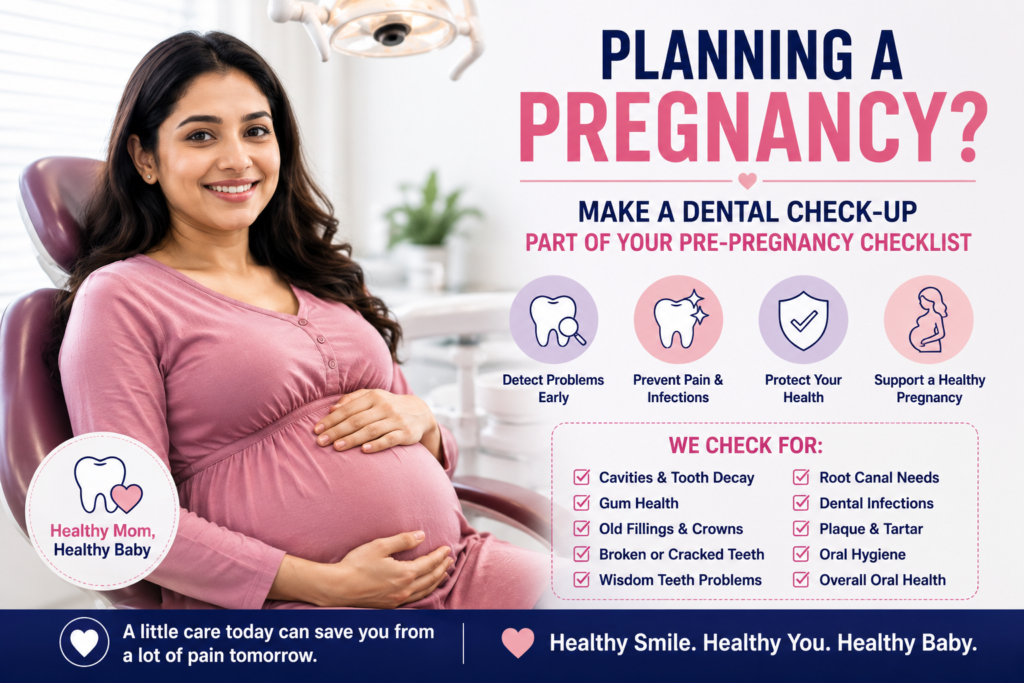
Why Dental Health Matters Before Pregnancy
When a couple starts planning a pregnancy, there are usually many things they think about:
- A gynecologist’s appointment
- Blood tests
- Folic acid
- Diet
- Exercise
- Medications
- Lifestyle changes
But there is one important health check that often gets forgotten:
A dental check-up.
As a dentist, I strongly believe that if you are planning to become pregnant, it is a good idea to get your dental health checked before pregnancy.
Pregnancy brings significant hormonal and lifestyle changes. If you already have a cavity, gum disease, a broken tooth, or an old dental problem waiting to flare up, pregnancy may not be the best time to discover it.
A few months of preventive dental care before pregnancy can save you from a lot of unnecessary pain and difficulty later.
Why Should You See a Dentist Before Planning a Pregnancy?
Think of it this way.
Before starting a long journey, you service your car. You check the tyres, check the engine, and make sure everything is working properly.
Your mouth deserves the same kind of preparation.
If you are planning a pregnancy, this is a good time to find out whether you have:
- Cavities
- Deep decay
- Gum inflammation
- Gum bleeding
- Broken or fractured teeth
- Old leaking fillings
- Wisdom tooth problems
- Teeth requiring root canal treatment
- Dental infections
- Poor oral hygiene
- Excessive plaque or tartar
- Problems with existing crowns or bridges
Some of these problems may not cause any pain today. But that doesn’t necessarily mean they will remain quiet throughout pregnancy.
“My Teeth Don’t Hurt, So Why Should I Visit a Dentist?”
This is one of the most common questions I hear.
The problem is that many dental problems remain silent in their early stages.
A cavity may be painless. Gum disease may cause little or no discomfort. An old filling may look fine but have leakage underneath. A tooth may have an early crack without causing significant symptoms.
By the time severe pain appears, treatment may become more complicated.
So, a pre-pregnancy dental check-up isn’t about treating something that is hurting.
It is about finding and dealing with potential problems before they become urgent.
Pregnancy Can Change Your Oral Health
Pregnancy is accompanied by major hormonal changes.
These hormonal changes can make the gums more reactive to plaque and may increase the tendency toward gingival inflammation.
You may notice:
- Bleeding while brushing
- Swollen gums
- Red or tender gums
- Increased gum sensitivity
- Bad breath
This is why gum health deserves particular attention before and during pregnancy.
If you already have gum inflammation before becoming pregnant, it makes sense to address it rather than waiting until the problem becomes more noticeable.
What About Cavities During Pregnancy?
Pregnancy itself does not automatically cause cavities.
However, pregnancy can bring changes that may make maintaining oral health more challenging.
For example, some women experience:
- More frequent eating
- Increased cravings
- More frequent consumption of sweet foods
- Changes in appetite
- Nausea and vomiting
- Acid exposure from vomiting
- Changes in oral hygiene habits
- Dry mouth in some cases
If sugary foods and drinks become more frequent, the teeth may be exposed to acid-producing bacteria more often.
A small cavity that was previously manageable can then progress.
And there is another problem.
Sometimes a cavity that was only mildly sensitive before pregnancy can suddenly become extremely painful.
Imagine Having Acute Tooth Pain During Pregnancy
This is something I would particularly like couples to think about.
You have just found out that you are pregnant.
You are excited. You are planning your appointments and preparing for the baby.
Then suddenly, one night, a tooth starts hurting.
At first you think:
“Maybe it will settle down.”
But the pain gets worse.
You can’t sleep. You can’t eat properly. You are afraid to take medication because you are pregnant.
And now you are faced with another question:
“Can I even have a root canal during pregnancy?”
This is exactly the situation we would prefer to prevent.
There are situations where necessary dental treatment can safely be provided during pregnancy. But wouldn’t it be better to identify and treat a potentially troublesome tooth before pregnancy whenever possible?
That is the whole idea behind a pre-pregnancy dental check-up.
What Should Be Checked Before Pregnancy?
A good dental examination should look beyond just “Do I have a cavity?”
I would recommend checking several things.
1. Teeth and Cavities
Look for existing decay and areas where food is getting trapped.
If a cavity is small, it may be much easier to restore it before pregnancy than to wait until it becomes painful.
2. Deep Cavities
A deep cavity close to the nerve deserves particular attention.
If the tooth is already showing signs that the pulp may be involved, it is better to assess it before pregnancy rather than waiting for an acute episode.
3. Gum Health
This is extremely important.
The dentist should check for:
- Plaque
- Tartar
- Bleeding gums
- Gingivitis
- Periodontal pockets
- Gum recession
- Existing periodontal disease
If gum treatment is required, it can be planned before pregnancy.
4. Existing Dental Restorations
Old fillings, crowns and bridges should be examined.
A restoration that is already failing may eventually cause trouble.
5. Wisdom Teeth
If a wisdom tooth repeatedly becomes painful or infected, it is worth discussing before pregnancy.
6. Broken or Cracked Teeth
A cracked tooth that is currently manageable can sometimes become a much bigger problem later.
7. Oral Hygiene
Your dentist can identify areas where plaque is accumulating and help you improve your brushing and interdental cleaning technique.
Why Gum Health Is Particularly Important
When we talk about pregnancy and dental health, many people immediately think about cavities.
But gum health deserves equal attention.
Pregnancy can make gums more sensitive to plaque.
A woman who already has bleeding or inflamed gums before pregnancy should not simply ignore it.
Professional cleaning, improved home care and treatment of existing gum disease can help establish a healthier oral environment before pregnancy.
This is much better than waiting until the gums are swollen and bleeding significantly.
What About Sweet Cravings During Pregnancy?
This is something we should talk about openly.
Pregnancy can bring strong food cravings. For some women, this includes chocolates, sweets, biscuits, desserts or sweetened drinks.
There is nothing unusual about having cravings.
The problem is frequent exposure to sugar throughout the day.
If you are constantly sipping sweet drinks or eating small amounts of sugary food repeatedly, your teeth are exposed to an environment that favours tooth decay.
Instead of worrying about never eating anything sweet, focus on:
- Reducing frequent snacking
- Avoiding continuous sipping of sugary drinks
- Drinking water regularly
- Maintaining good brushing habits
- Cleaning between the teeth
- Having regular dental check-ups
A sensible approach is much more realistic than trying to completely eliminate every craving.
What If You Have Morning Sickness?
Vomiting can expose the teeth to stomach acid.
Repeated acid exposure can contribute to dental erosion.
One simple precaution is important:
Don’t brush your teeth aggressively immediately after vomiting.
Instead, rinse your mouth with water and follow your dentist’s advice about when and how to brush.
If morning sickness is frequent or severe, mention it to your dentist and gynecologist.
Why Treating Dental Problems Before Pregnancy Can Be Easier
This is not because dental treatment cannot be done during pregnancy.
Necessary dental treatment can be provided during pregnancy when clinically indicated.
The point is simply that prevention gives you more flexibility.
Before pregnancy, you can comfortably schedule:
- Dental fillings
- Professional cleaning
- Treatment of gum disease
- Root canal treatment when necessary
- Replacement of failing restorations
- Management of problematic wisdom teeth
- Treatment of cracked or broken teeth
You can complete the necessary work and enter pregnancy without worrying about a tooth that has been troubling you for months.
Should You Finish Every Dental Treatment Before Pregnancy?
Not necessarily.
This is an important distinction.
You don’t need to have every cosmetic dental procedure completed before becoming pregnant.
Routine cosmetic work that can safely wait can be postponed.
The priority should be:
Remove active disease and potential sources of acute dental problems.
That means dealing with things such as:
- Significant decay
- Active gum disease
- Infections
- Painful teeth
- Other conditions that may reasonably be expected to cause problems
What If You Are Already Planning a Pregnancy?
Don’t panic if you haven’t had a dental check-up yet.
Simply make an appointment.
Tell your dentist:
“We are planning a pregnancy.”
That information is useful because it allows your dentist to think ahead.
The dentist can examine your teeth and gums, identify anything that needs treatment and plan procedures appropriately.
If diagnostic X-rays are required, they can be discussed based on your individual situation and whether they are clinically necessary.
The goal is not to do unnecessary treatment.
The goal is to remove avoidable problems before pregnancy whenever possible.
What If You Are Already Pregnant?
If you are already pregnant, don’t worry.
It is not too late.
Continue taking care of your teeth and gums and arrange a dental examination if you haven’t had one recently.
And if you develop severe pain, swelling or a dental infection, don’t simply suffer until delivery.
Tell your dentist that you are pregnant.
Necessary dental treatment can be provided during pregnancy when clinically indicated, with appropriate precautions.
A Simple Pre-Pregnancy Dental Checklist
If you are planning a pregnancy, consider discussing these points with your dentist:
- ☐ Complete dental examination
- ☐ Check for cavities
- ☐ Check for deep decay
- ☐ Evaluate existing fillings and crowns
- ☐ Check for cracked or broken teeth
- ☐ Professional cleaning if required
- ☐ Evaluate gum bleeding and inflammation
- ☐ Check for periodontal disease
- ☐ Assess problematic wisdom teeth
- ☐ Review any tooth that has previously required treatment
- ☐ Discuss any recurring dental pain
- ☐ Review your oral hygiene routine
- ☐ Discuss dietary habits and frequent sugar exposure
- ☐ Complete necessary treatment where appropriate
This doesn’t mean every woman needs every procedure.
It simply means that these areas should be considered.
One Small Dental Visit Can Prevent a Big Problem
This is the main message I want couples planning a pregnancy to remember.
You don’t need to be afraid of the dentist.
You don’t need to wait until something hurts.
And you don’t need to think about dental health only after pregnancy begins.
If you’re planning a pregnancy, make dental health part of your preparation.
Get your teeth checked.
Get your gums checked.
Treat problems that need treatment.
Improve your oral hygiene.
And then you can enter pregnancy knowing that you’ve taken care of one more important part of your health.
A Message From Dr. Durgaprasad Hiwale
When a couple tells me that they are planning a baby, I often think about all the preparation they are already doing.
They are taking supplements. They are changing their diet. They are visiting their gynecologist. They are trying to become healthier.
I would simply add one more thing to that list:
Please visit your dentist.
A dental check-up before pregnancy is not about doing unnecessary treatment.
It is about identifying problems while they are still manageable.
A small cavity can be treated. Inflamed gums can be addressed. A problematic tooth can be evaluated. And a potential source of severe pain can sometimes be dealt with before it becomes an emergency during pregnancy.
Pregnancy is a special journey.
You have enough to think about without adding a sleepless night because of a toothache.
Take Care of Your Dental Health Before You Start the Journey.
Your future self — and perhaps your future pregnant self — will thank you.
Dr. Durgaprasad Hiwale
MDS Endodontics
Sanjivan Dental
Medical Disclaimer
This article is intended for general educational purposes and does not replace a personal examination by a dentist or advice from your gynecologist/obstetrician.
Every patient and pregnancy is different. Dental treatment and diagnostic procedures should be planned according to the individual’s clinical condition and medical history.