By Dr. Durga Prasad Hiwale, Sanjivan Dental
A patient who has recently received an implant sometimes tells me:
“Doctor, an implant is artificial, so how can it get an infection?”
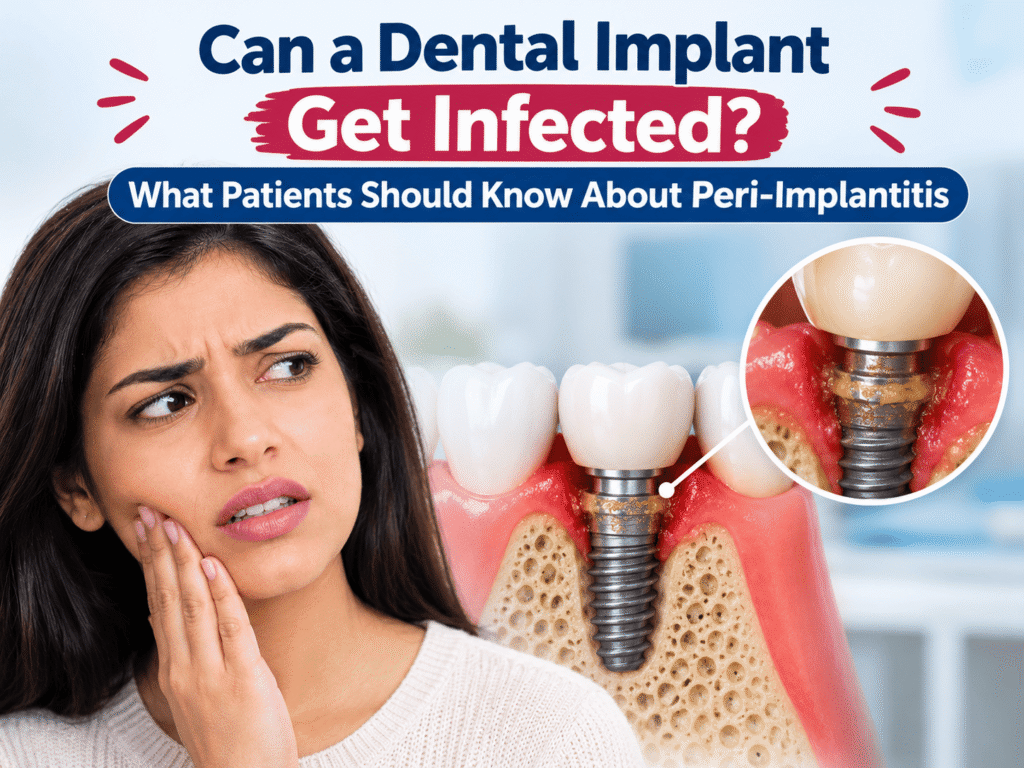
It is a very good question. The implant itself is made from a biocompatible material, but an implant does not exist in isolation. It sits inside living bone and gum tissue, and those tissues can develop inflammation or infection.
So yes, dental implants can develop problems around them. One of the most important conditions is called peri-implantitis.
An Implant Is Not Completely Maintenance-Free
There is a common perception that once an implant is placed: “Now I don’t have to worry about that tooth anymore.”
Unfortunately, that’s not true. An implant cannot develop a cavity in the same way a natural tooth can, but the tissues surrounding it still need to be maintained.
Bacteria can accumulate around the implant and cause inflammation. Initially, this may involve only the soft tissues around the implant. If the inflammation progresses and bone starts being lost around the implant, it may become peri-implantitis.
How Does It Begin?
Often, the process starts quietly. You may notice:
- Bleeding while cleaning around the implant
- Swollen or tender gums
- A bad taste in your mouth
- Persistent bad breath
- Pus around the implant
- Increasing discomfort
- Changes in the gum contour around the implant
Sometimes there may be very little pain. That is why bleeding around an implant should never be ignored.
Why Can Bone Loss Happen Around an Implant?
There isn’t always one single reason. Several factors can contribute:
- Poor Plaque Control: If bacterial deposits remain around the implant, inflammation can develop.
- Previous or Existing Gum Disease: Patients who have a history of periodontal disease require particularly careful long-term maintenance.
- Smoking: Smoking can adversely affect periodontal and peri-implant tissues and impair healing.
- Implant Position: An implant that is poorly positioned can create hygiene difficulties and complicate the surrounding soft-tissue and prosthetic environment.
- Prosthetic Design: The crown should allow the patient to clean around the implant appropriately. A technically successful implant can still become difficult to maintain if the final restoration doesn’t provide adequate hygiene access.
- Excessive Forces: Occlusal overload (bite pressure) may also be relevant in certain cases and needs to be evaluated along with biological factors.
“My Implant Doesn’t Hurt, So Everything Must Be Fine”
Not necessarily. This is one of the reasons regular implant maintenance matters. Bone loss around an implant may progress without dramatic pain. A clinical examination can identify changes that a patient may not notice.
Depending on the situation, your dentist may evaluate:
- Gum condition and bleeding
- Probing depth measurements
- Implant stability
- Bite forces
- Prosthetic design
- Radiographic bone levels
The earlier a problem is identified, the more options there may be for management.
Can Peri-Implantitis Be Treated?
Treatment depends on how advanced the condition is and what caused it. Early inflammation around an implant is managed differently from advanced peri-implantitis with significant bone loss.
Treatment can involve:
- Professional debridement
- Improved home-care measures
- Correction of local contributing factors
- Management of the prosthesis
- Treatment of the implant surface when indicated
- Surgical treatment in selected cases
If an implant has become severely compromised, removal may sometimes become necessary. Again, there is no single treatment that applies to every implant.
Prevention Is Much Easier Than Treating Advanced Implant Disease
This is perhaps the most important message. When we place an implant, we don’t consider the treatment complete when the crown is delivered.
The patient now has a long-term maintenance responsibility. Daily cleaning around the implant matters.
Depending on the individual situation, this may involve:
- Toothbrush
- Interdental brush
- Floss designed specifically for implant areas
- Water flosser
- Professional maintenance and cleaning
The exact cleaning method should be individualized.
Implant Dentistry Is Not Just About the Surgery
A successful implant has several components:
$$\text{Planning} \longrightarrow \text{Correct Placement} \longrightarrow \text{Good Prosthetic Design} \longrightarrow \text{Healthy Surrounding Tissues} \longrightarrow \text{Long-Term Maintenance}$$
If one of these is neglected, the long-term result can be affected. This is why I tell patients:
“The day we put your implant in is not the day your responsibility ends. It is the day your maintenance begins.”
What About an Implant That Has Been Working Well for Years?
An implant can function successfully for many years, but even a previously successful implant should continue to be monitored. Changes in gum health, hygiene, bite, or the surrounding bone can occur over time.
So if you have an implant, don’t wait for it to become loose before visiting your dentist. An implant that is moving is already telling you that something significant may have happened. Regular review gives us a better opportunity to identify problems earlier.
At Sanjivan Dental
When we plan implant treatment, we don’t look only at the implant. We consider the bone, gum, bite, prosthesis, and the patient’s ability to maintain the area.
The objective is not simply: “Place an implant successfully.”
The objective is: “Create an implant restoration that can be maintained and function comfortably for the long term.”
Because an implant is an excellent tooth-replacement option—but it is not a maintenance-free tooth.