By Dr. Durga Prasad Hiwale, Sanjivan Dental
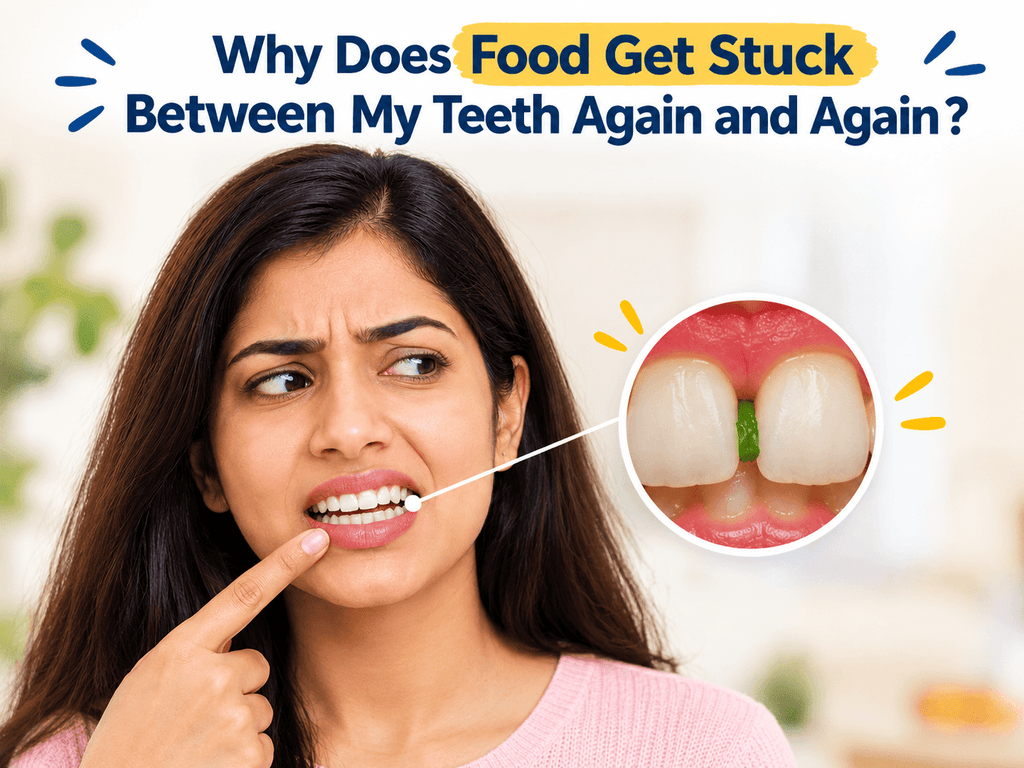
“Doctor, every time I eat, food gets stuck between these two teeth. I have to use a toothpick after almost every meal.”
It sounds like a small problem. But when food repeatedly gets trapped in the same place, I don’t consider it something to simply live with.
Usually, there is a reason. And finding that reason is more useful than simply telling the patient to floss more.
Food Getting Stuck Is Not Always Because You Are Eating the Wrong Food
Patients often blame themselves:
- “Maybe I don’t brush properly.”
- “Maybe I should stop eating fibrous food.”
- “I keep cleaning it, but it comes back.”
If food is consistently getting impacted between the same two teeth, there may be a problem with the contact or shape of the teeth.
Some common causes include:
- Decay between the teeth
- An old or defective filling
- A broken tooth or filling
- Loss of the normal contact point
- Gum or bone loss
- Tilted or rotated teeth
- An improperly shaped crown
- Changes caused by tooth movement
So the first question should be: Why is the food getting trapped?
Your Teeth Are Supposed to Touch Each Other
Healthy adjacent teeth normally have a tight contact area that helps prevent food from being forced directly into the gum between them.
When that contact becomes loose, open, or incorrectly positioned, food can repeatedly get pushed into the space during chewing.
And then the patient starts carrying a toothpick everywhere. But the toothpick is only dealing with the symptom—it doesn’t correct the underlying problem.
Sometimes the Cause Is a Cavity You Cannot See
A cavity between two teeth can be difficult for a patient to notice. You may look in the mirror and think: “There is no cavity there.”
But decay can develop in an area that is not easily visible. Sometimes a clinical examination and an appropriate X-ray are needed to identify it.
This is one reason why recurrent food impaction should not automatically be dismissed as a cleaning problem.
An Old Filling Can Also Be Responsible
This is something I see quite frequently. A tooth may have been restored years ago.
The filling may still appear perfectly acceptable to the patient, but the contact between the two teeth may no longer be ideal.
- Food starts getting trapped.
- The patient keeps cleaning it.
- The gum remains irritated.
- Eventually, the problem becomes persistent.
In such a situation, simply doing more cleaning may not solve the problem—the restoration itself may need to be evaluated.
What Happens When Food Repeatedly Enters the Gum?
This is where a small annoyance can become a bigger dental problem. Repeated food impaction can irritate the gum between the teeth, leading to:
- Bleeding
- Tenderness
- Swelling
- Bad breath
- Soreness while chewing
If the underlying cause continues for a long time, the local periodontal tissues can also be affected. So if one particular area repeatedly traps food, it is worth having it examined.
Sometimes the Tooth Itself Has Moved
As we age, teeth don’t necessarily remain in exactly the same position forever. Teeth can drift or tilt, particularly when neighbouring teeth have been lost.
If one tooth has moved, the relationship between the two teeth can change. Suddenly, a space that previously wasn’t there becomes a place where food gets trapped.
In such cases, the solution may be very different from replacing a filling—the underlying tooth position may need to be considered.
Crowns Can Also Cause Food Impaction
A crown is supposed to restore the shape and function of a tooth, reproducing the appropriate contact with the neighbouring tooth.
If the contact is too open or the contour is incorrect, the patient may notice:
“Ever since I got this crown, food keeps getting stuck here.”
That is useful information. It doesn’t necessarily mean the crown has failed completely, but the contact and contour should be checked.
Should You Use a Toothpick?
Occasionally using a toothpick to remove food may seem harmless, but repeatedly poking the gum can traumatize it.
For cleaning between teeth, appropriately used interdental brushes or dental floss may be more suitable depending on the size and anatomy of the space.
However, there is an important distinction: Cleaning the food out is not the same as correcting why the food is getting there. If the same spot needs cleaning after every meal, find the cause.
What Do We Check at Sanjivan?
When a patient comes with recurrent food impaction, I don’t simply say: “Start flossing.”
I look at the area clinically. Depending on the situation, we may evaluate:
- Contact between the teeth
- Presence of decay
- Existing fillings or crowns
- Gum condition and bone levels
- Tooth position and bite
- Food trap anatomy
Sometimes the solution is surprisingly simple—a defective restoration may need correction, decay may need treatment, or periodontal therapy may be required.
One Small Symptom Can Be an Early Warning
Don’t ignore a recurring food trap just because it isn’t painful. Your mouth is giving you information.
- If food gets stuck once because you ate something fibrous, that’s normal.
- If it gets stuck between the same two teeth every single day, that’s different.
It is worth asking: “Why has this space changed?” Because treating the reason early can sometimes prevent a much bigger problem later.
At Sanjivan Dental
Our approach is to look beyond the immediate complaint. If a patient says: “Food gets stuck here,” we don’t want to give only a solution for today’s food. We want to understand why that particular area is trapping food in the first place.
Good dentistry isn’t just about making a tooth look good—it is also about restoring the tiny details like contact, contour, function, and hygiene access that allow the teeth and gums to work comfortably together.