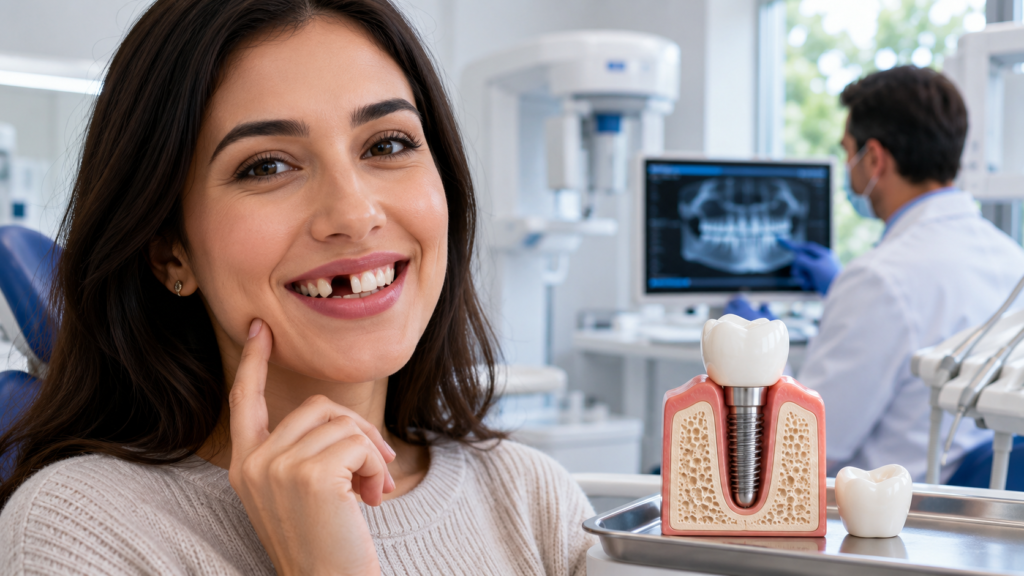
Many people believe that losing a single tooth is only a cosmetic concern. In reality, even one missing tooth can affect your ability to chew, alter your speech, weaken your jawbone, and change the alignment of your remaining teeth.
A dental implant is one of the most reliable and long-lasting solutions for replacing a missing tooth because it replaces both the tooth root and the visible crown, restoring function as well as appearance.
If you’ve lost a tooth, don’t ignore it. Here are seven important signs that indicate it may be time to consider replacing your missing tooth with a dental implant.
1. You Have Difficulty Chewing Food
If you avoid chewing on one side of your mouth after losing a tooth, it may be affecting your daily life more than you realize.
When a tooth is missing, the surrounding teeth are forced to handle extra chewing pressure. Over time, this can lead to uneven wear, discomfort, and additional strain on your bite.
A dental implant restores normal chewing function and distributes biting forces more naturally.
2. Your Nearby Teeth Are Starting to Shift
Teeth naturally move toward empty spaces.
Over time, a missing tooth can cause neighbouring teeth to drift, leading to:
- Crooked or tilted teeth
- Food trapping between teeth
- Bite problems
- Difficulty cleaning certain areas
Replacing the missing tooth early helps maintain proper tooth alignment and reduces future dental complications.
3. You Notice Changes in Your Face or Jaw
Your jawbone depends on stimulation from natural tooth roots to remain healthy.
After a tooth is lost, the bone in that area gradually shrinks because it no longer receives normal chewing forces. As bone loss progresses, it may affect facial appearance and make future treatment more challenging.
Dental implants help preserve the jawbone by stimulating it in a way that closely resembles a natural tooth root.
4. Food Frequently Gets Stuck Between Your Teeth
An empty space left by a missing tooth often traps food particles.
This can increase the risk of:
- Tooth decay
- Gum disease
- Bad breath
- Gum inflammation
Replacing the missing tooth helps reduce food impaction and makes maintaining good oral hygiene much easier.
5. Your Smile Has Changed
Even if the missing tooth isn’t visible when you smile, it can gradually affect your appearance.
As neighbouring teeth shift and bone loss develops, your bite and facial support may change, making your smile appear uneven.
Replacing the missing tooth early helps maintain a natural, balanced smile.
6. Your Speech Has Changed
Many speech sounds require proper contact between the tongue and teeth.
Missing teeth—especially front teeth—can affect pronunciation and reduce speech clarity.
A dental implant restores the natural position of the tooth, helping improve speech in many patients.
7. Your Denture or Bridge Feels Uncomfortable
If you currently wear a removable denture or have an older bridge that feels loose or uncomfortable, dental implants may provide a more stable and comfortable solution.
Implant-supported restorations offer improved comfort, better chewing efficiency, and greater confidence while speaking and eating.
Why Choose a Dental Implant?
Dental implants offer several important advantages over other tooth replacement options.
Benefits of Dental Implants
- Replace both the missing tooth and its root
- Help preserve the jawbone
- Restore natural chewing ability
- Do not require grinding healthy neighbouring teeth
- Can last for many years with proper care
- Look, feel, and function like natural teeth
How We Plan Implant Treatment at Sanjivan Dental
At Sanjivan Dental, every implant treatment begins with a comprehensive clinical examination and an in-house CBCT scan to obtain a three-dimensional view of your jawbone.
Our digital planning process helps evaluate:
- Bone quantity and quality
- Ideal implant position
- Implant angulation
- Important anatomical structures
- Prosthetically driven implant placement
Every treatment plan is carefully customised to meet each patient’s individual oral condition and functional needs.
Can Every Missing Tooth Be Replaced with a Dental Implant?
Many patients are suitable candidates for dental implants. However, eligibility depends on several important factors, including:
- Overall oral health
- Bone quantity and quality
- Gum health
- Medical history
- Smoking habits
A detailed consultation and CBCT evaluation help determine the most appropriate treatment option for your specific needs.
Frequently Asked Questions
Is getting a dental implant painful?
Dental implant placement is performed under local anaesthesia. Most patients experience only mild discomfort for a few days, which is usually well controlled with prescribed medications.
How long do dental implants last?
With proper oral hygiene, regular dental check-ups, and professional maintenance, dental implants can function successfully for many years.
What happens if I don’t replace a missing tooth?
Delaying treatment may lead to jawbone loss, shifting of neighbouring teeth, bite problems, and increased treatment complexity over time.
Can older adults get dental implants?
Yes. Age alone is not a limiting factor. Many healthy older adults are excellent candidates after a comprehensive dental evaluation.
How soon should I replace a missing tooth?
In many cases, replacing a missing tooth as early as possible helps preserve bone and simplify treatment. However, the ideal timing varies for each patient and should be determined after a professional examination.
Conclusion
A missing tooth affects much more than your appearance. It can reduce your ability to chew comfortably, change your speech, affect your oral health, and influence the stability of your remaining teeth.
If you’ve lost a tooth and notice any of these warning signs, don’t wait. An early consultation can help identify the best treatment option and prevent more complex dental problems in the future.
At Sanjivan Dental, we combine advanced CBCT imaging, digital implant planning, and modern implant techniques to provide safe, precise, and long-lasting tooth replacement solutions.
Book your consultation today and take the first step toward restoring your healthy, confident smile.