Losing teeth can affect much more than your smile. Missing teeth can make chewing difficult, affect speech, and gradually change the way your remaining teeth function.
Fortunately, there are several options available to replace missing teeth. Two of the most common choices are dentures and dental implants.
So, which option is better?
The answer depends on several factors, including your oral health, bone condition, number of missing teeth, overall health, and personal treatment goals.
What Are Dentures?
Dentures are removable dental appliances designed to replace missing teeth. They can be used to replace several missing teeth or a complete set of teeth in one or both jaws.
Modern dentures can be designed to look natural and can help restore basic chewing ability, speech, and appearance.
However, because conventional dentures are removable, some patients may experience movement or discomfort while eating and speaking.
Dentures Can Replace:
- Several missing teeth
- Most or all teeth in the upper jaw
- Most or all teeth in the lower jaw
- Complete tooth loss in both jaws
What Are Dental Implants?
Dental implants are artificial tooth roots that are placed into the jawbone to replace the root portion of missing teeth.
After appropriate healing, or according to the planned loading protocol, dental implants can be used to support different types of restorations.
Dental Implants Can Support:
- Individual dental crowns
- Implant-supported bridges
- Implant-supported dentures
- Full-arch fixed teeth
Unlike conventional removable dentures, implant-supported restorations provide a more stable and fixed solution for replacing missing teeth.
Why Do Many Patients Prefer Dental Implants?
Dental implants offer several advantages when compared with conventional removable dentures.
Better Stability
Implant-supported teeth are securely anchored and do not move in the same way as conventional removable dentures.
Improved Chewing
A stable tooth replacement can make eating more comfortable and improve chewing efficiency.
Natural Appearance
Modern implant restorations can be customized to closely match the shape, size, and appearance of natural teeth.
Bone Preservation
When an implant is successfully integrated with the jawbone, it can help maintain bone around the implant site.
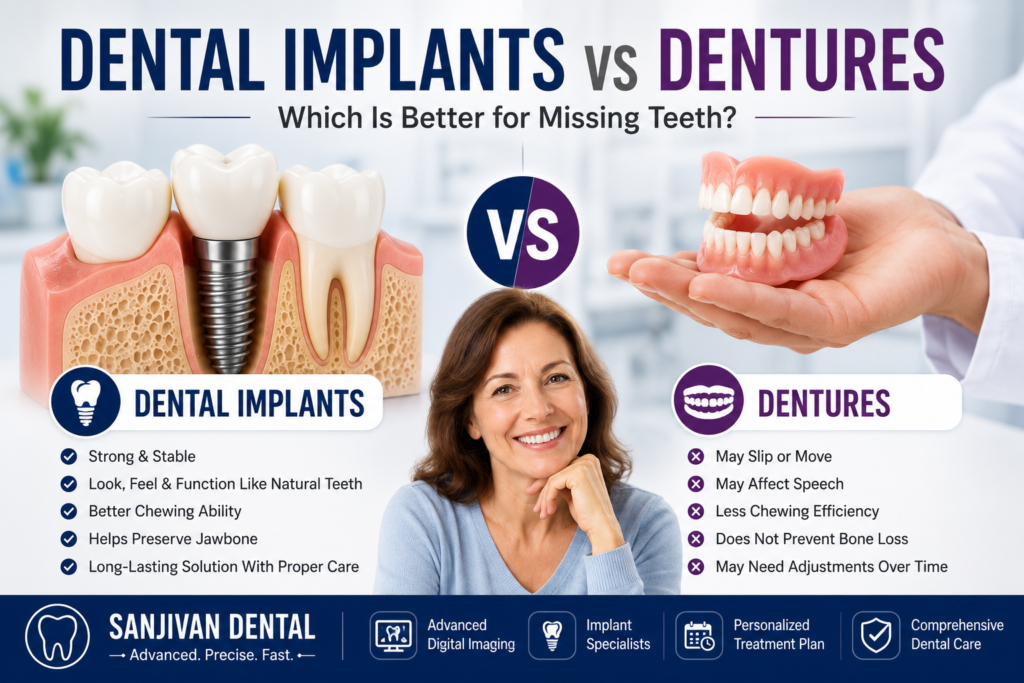
Dental Implants vs Dentures: What Is the Difference?
Both options can replace missing teeth, but they work in different ways.
Dental Implants
- Fixed or implant-supported
- Greater stability
- Improved chewing efficiency
- Natural-looking appearance
- Help maintain bone around the implant site
- Do not usually require support from adjacent natural teeth
Conventional Dentures
- Removable
- Generally more affordable initially
- Can replace multiple or all missing teeth
- May move during eating or speaking
- Require regular maintenance and adjustment
- Do not provide the same bone stimulation as a natural tooth root or implant
The right option depends on your individual dental condition and treatment goals.
Are Dental Implants Suitable for Everyone?
Not necessarily.
Before recommending dental implants, your dentist will evaluate several factors to determine whether they are appropriate for you.
Your Dentist May Assess:
- Bone quantity and quality
- Gum health
- Remaining natural teeth
- Bite and chewing forces
- Medical history
- Oral hygiene
- Smoking and other lifestyle risk factors
In appropriate cases, CBCT imaging can provide detailed three-dimensional information about the jawbone and important anatomical structures, helping with treatment planning.
Can Missing Teeth Be Replaced Quickly?
In selected patients, immediate-loading implant treatment may allow fixed teeth to be provided much sooner than traditional implant treatment protocols.
However, immediate loading is not suitable for every patient or every implant case.
Factors such as bone quality, implant stability, bite forces, and overall oral health need to be carefully evaluated before this treatment is recommended.
A detailed clinical examination and proper digital treatment planning are essential.
Which Option Is Right for You?
There is no single tooth-replacement solution that is best for everyone.
For some patients, conventional dentures may be an appropriate and practical option. For others, dental implants or implant-supported teeth may provide greater stability and a more suitable long-term solution.
The best way to determine the right treatment is to have a comprehensive dental examination and discuss your options with an experienced implant dentist.
Why Choose Sanjivan Dental?
At Sanjivan Dental, we use modern diagnostic technology and personalized treatment planning to help patients choose the most suitable solution for missing teeth.
Our approach may include:
- Clinical examination
- CBCT-based evaluation when required
- Digital treatment planning
- Dental implant treatment
- Implant-supported restorations
- Immediate-loading options for suitable patients
- Personalized treatment plans
Every patient has different needs, and our treatment recommendations are based on individual oral health, bone condition, functional requirements, and expectations.
Conclusion
Missing teeth can affect your chewing, speech, oral health, and confidence. Fortunately, modern dentistry offers several effective ways to replace missing teeth.
Dentures can provide a removable and practical solution, while dental implants can offer greater stability and a more fixed tooth-replacement option.
The best choice depends on your individual dental condition, overall health, bone support, and treatment goals.
Don’t simply learn to live with missing teeth. Explore your tooth-replacement options and find out which solution is right for you.
Book Your Consultation at Sanjivan Dental
Sanjivan Dental — Advanced. Precise. Fast.