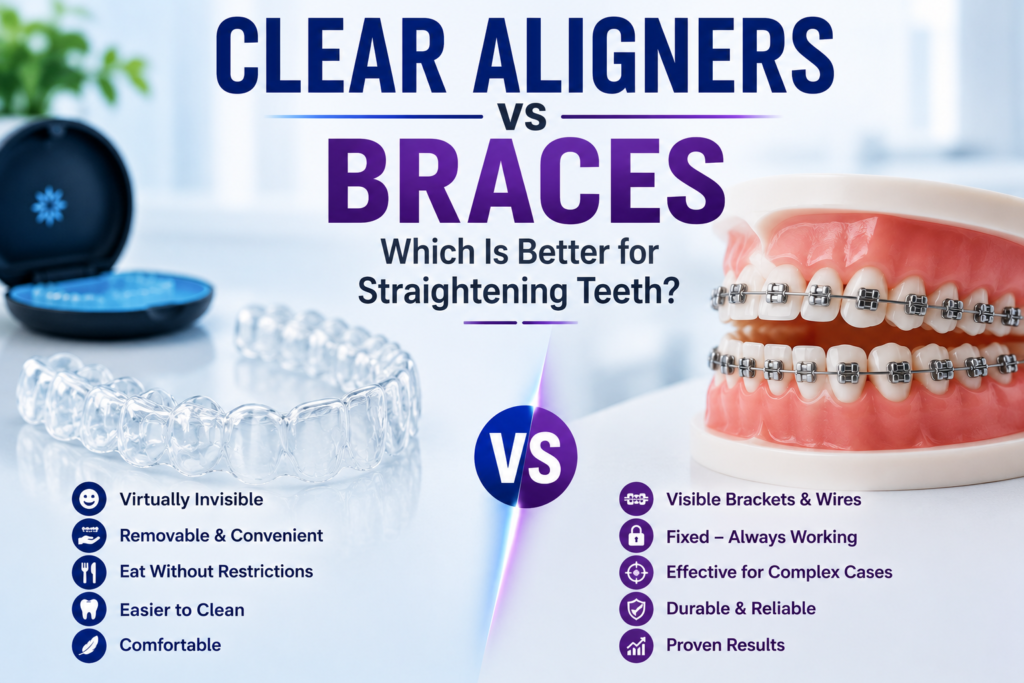
If you have crowded teeth, gaps, rotated teeth, or a bite problem, you may have been told that orthodontic treatment can help. Today, patients have more than one option for straightening their teeth.
The two most commonly discussed choices are traditional braces and clear aligners.
Traditional braces use brackets and wires attached to the teeth, while clear aligners use a series of removable, transparent trays that gradually move the teeth into their planned positions.
So, which is better—clear aligners or braces?
The answer depends on your teeth, bite, treatment requirements, lifestyle, and the treatment plan created by your orthodontist.
What Are Traditional Braces?
Traditional braces use small brackets attached to the teeth and connected with orthodontic wires.
The wires apply controlled forces to gradually move the teeth. During treatment, the orthodontist periodically adjusts the appliance so that the teeth continue moving according to the treatment plan.
Braces have been used successfully for decades and can treat a wide range of orthodontic problems.
What Are Clear Aligners?
Clear aligners are transparent, removable orthodontic trays designed specifically for your teeth.
Instead of brackets and wires, a patient receives a series of aligners. Each aligner is designed to make small, controlled changes in tooth position.
As treatment progresses, the patient changes to the next aligner according to the orthodontist’s instructions.
Modern aligner treatment generally begins with digital scanning and computer-assisted treatment planning.
At Sanjivan Dental, digital technology can be used to assess the teeth and create a detailed treatment plan before treatment begins.
Clear Aligners vs Braces: Key Differences
1. Appearance
Appearance is one of the biggest reasons adults consider clear aligners.
Traditional braces are visible because of their brackets and wires. Clear aligners are designed to be much less noticeable when worn.
For people who are concerned about the appearance of orthodontic treatment, this can be an important advantage.
2. Removability
Traditional braces remain attached to the teeth throughout treatment.
Clear aligners are removable and can generally be taken out while eating, drinking certain beverages, and cleaning your teeth, according to your orthodontist’s instructions.
However, this advantage also means that patient compliance is extremely important.
If aligners are not worn for the recommended amount of time, treatment may not progress as planned.
3. Eating
Braces can make certain foods difficult to eat because hard or sticky foods can damage brackets or wires.
With clear aligners, the aligners are normally removed before eating.
This allows patients to maintain a more normal diet while continuing to follow good oral hygiene practices.
4. Cleaning Your Teeth
Maintaining good oral hygiene is important during any orthodontic treatment.
With braces, patients need to clean carefully around brackets and wires.
Clear aligners can be removed, making normal brushing and flossing easier. However, the aligners themselves also need to be cleaned properly.
5. Comfort
Both braces and clear aligners apply pressure to move teeth. Therefore, neither option is completely sensation-free.
Patients may experience temporary pressure, tightness, or mild discomfort when teeth are being moved.
Clear aligners do not have metal brackets and wires that can sometimes irritate the cheeks or lips, although they can still cause temporary irritation or pressure.
Are Clear Aligners Better Than Braces?
Not necessarily.
Clear aligners can be an excellent option for many patients, but they are not automatically better for everyone.
The correct treatment depends on factors such as:
- Amount of crowding
- Tooth rotations
- Spaces between teeth
- Bite problems
- Jaw relationships
- Tooth position
- Gum and bone health
- Previous orthodontic treatment
- Patient compliance
Some complex orthodontic cases may be better managed with braces or a combination of orthodontic techniques.
This is why a proper orthodontic evaluation is more important than simply choosing an appliance based on appearance.
How Long Does Orthodontic Treatment Take?
Treatment duration varies from patient to patient.
Some mild orthodontic corrections may take relatively little time, while more complex cases require considerably longer treatment.
Treatment duration depends on:
- The amount of tooth movement required
- The patient’s individual biology
- The treatment plan
- Patient compliance
- The complexity of the bite
With clear aligners, wearing the aligners as prescribed is particularly important.
Who May Be Suitable for Clear Aligners?
Clear aligners may be suitable for many teenagers and adults with orthodontic problems such as:
- Mild to moderate crowding
- Spaces between teeth
- Certain tooth rotations
- Some bite problems
- Relapse after previous orthodontic treatment
- Cosmetic alignment concerns
However, suitability cannot be determined accurately without examining the patient’s teeth and bite.
Clear Aligners Are Not Just About Straight Teeth
Orthodontic treatment isn’t simply about making the front teeth look straight.
A good treatment plan considers:
- Tooth position
- Bite
- Function
- Facial aesthetics
- Gum health
- Long-term stability
The goal should be to create a healthy, functional, and stable result, rather than simply moving visible teeth into a straight line.
Clear Aligners at Sanjivan Dental
At Sanjivan Dental, aligner treatment can be planned using digital scanning and computer-assisted treatment planning.
Digital impressions can help create a detailed representation of the patient’s teeth and allow orthodontic treatment to be planned more precisely.
Sanjivan Dental also provides SmylAlign clear aligners and Invisalign treatment.
The appropriate option depends on the patient’s individual orthodontic requirements.
Clear Aligners vs Braces: Which Should You Choose?
There is no universal answer.
Clear Aligners May Be Suitable When:
- You prefer a discreet orthodontic appliance.
- You want the convenience of removability.
- You are suitable for aligner treatment.
- You can follow the recommended wear schedule.
Braces May Be Suitable When:
- Your orthodontic problem requires fixed appliances.
- Your orthodontist believes braces can provide better control.
- Your specific case is more complex.
- Compliance with removable aligners may be difficult.
The best way to decide is to have your teeth and bite evaluated by an orthodontic professional.
Frequently Asked Questions
Are Clear Aligners Better Than Braces?
Clear aligners are better for some patients, while braces may be better for others. The appropriate treatment depends on the complexity of the orthodontic problem and the patient’s individual needs.
Are Clear Aligners Painful?
Clear aligners can cause temporary pressure or mild discomfort, particularly when starting a new aligner. This usually occurs because the aligner is applying controlled forces to move the teeth.
Can I Eat With Clear Aligners?
Typically, aligners are removed while eating. Your orthodontist will provide specific instructions regarding eating and drinking during treatment.
Can Clear Aligners Fix Crowded Teeth?
Clear aligners can correct many cases of dental crowding, but suitability depends on the severity and nature of the crowding.
Are Clear Aligners Suitable for Adults?
Yes. Adults are commonly treated with clear aligners, provided their teeth and supporting tissues are healthy and the orthodontic problem is suitable for aligner treatment.
Do I Need Retainers After Clear Aligner Treatment?
Yes. After orthodontic treatment, teeth can naturally tend to move. Retainers are usually recommended to help maintain the result.
Final Takeaway
Clear aligners and braces are both effective orthodontic treatment options.
The important question isn’t simply:
“Which looks better?”
The better question is:
“Which treatment is appropriate for my teeth, bite, and long-term goals?”
A professional orthodontic assessment can help determine whether clear aligners or braces are the right choice for you.