By Dr. Durga Prasad Hiwale, Sanjivan Dental
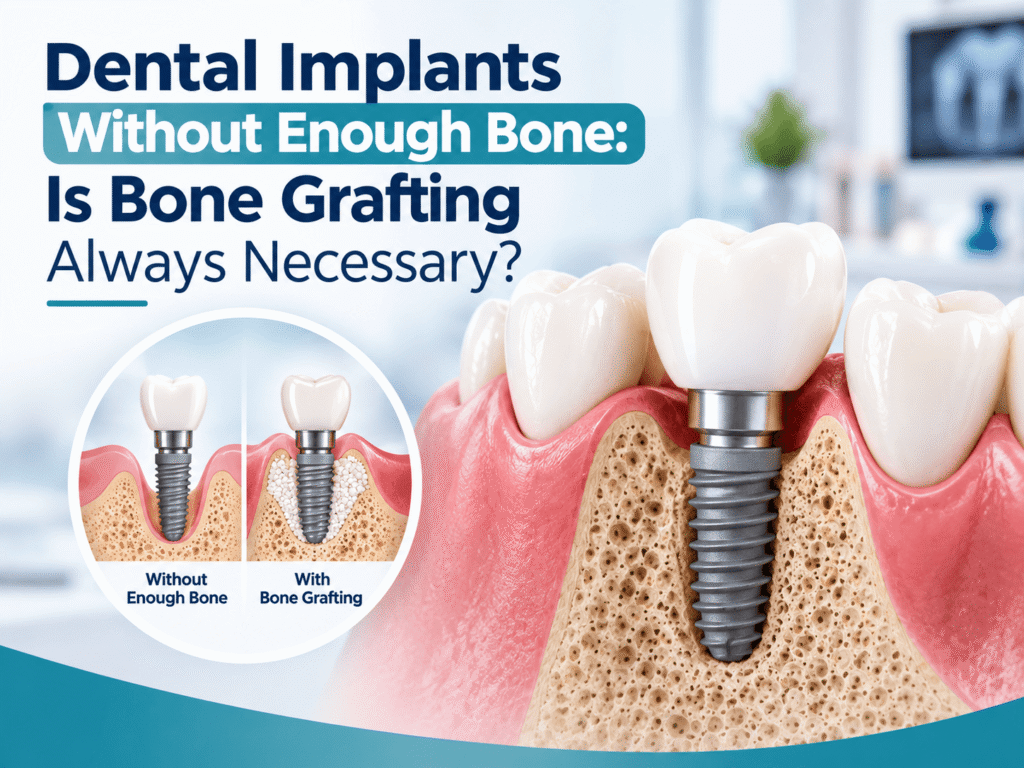
One of the most common things patients are told after losing a tooth is:
“You don’t have enough bone for an implant. First, you need a bone graft.”
Sometimes that is absolutely correct. But not every patient with reduced bone needs bone grafting.
This is something I feel patients should understand before they decide on treatment. When a tooth has been missing for a long time, the jawbone gradually becomes narrower and sometimes shorter.
That doesn’t necessarily mean that an implant is impossible—it simply means that the implant plan has to change.
Why Does Bone Disappear After Losing a Tooth?
The jawbone exists partly to support the tooth. Once the tooth is removed, the bone around that area no longer receives functional stimulation. Over time, the ridge can become:
- Narrower
- Shorter
- Irregular
- Deficient in certain areas
The amount of bone loss varies considerably between patients. That’s why I don’t like making an implant decision based only on how the gum looks from the outside—we need to know what is actually present underneath.
Is Bone Grafting the Only Solution?
No. Bone grafting is one option, but it is not the only way to manage deficient bone. Depending on the location and severity of the deficiency, treatment planning may involve different approaches:
- Conventional Implant + Bone Augmentation: When the deficiency is limited and the implant can be predictably positioned after augmentation, bone grafting is a sensible choice.
- Short Implants: In selected situations, a shorter implant allows us to avoid extensive augmentation while achieving an appropriate result.
- Angled Implants: Available bone can often be utilized by changing the angle and position of the implant rather than recreating the entire ridge.
- Pterygoid Implants: In severely resorbed posterior upper jaws (maxillae), the pterygoid region can provide alternative anchorage.
- Zygomatic Implants: In cases of severe maxillary bone loss, the zygomatic (cheek) bone offers another strong anchorage option.
These are not interchangeable treatments—the individual anatomy decides which option is appropriate.
Why CBCT Planning is Essential
For a severely resorbed area, a conventional 2D dental X-ray gives us a limited picture. A 3D CBCT scan allows us to thoroughly evaluate:
- Available bone width & height
- Sinus position & anatomical limitations
- Cortical bone & adjacent teeth positions
- Important structures like the inferior alveolar nerve
In complex cases, planning becomes even more vital. I don’t want to place an implant simply where there happens to be some bone; I want to plan where the implant should ideally go for the final tooth—and then determine how we can achieve that position safely.
A Real Clinical Situation vs. The Textbook
Consider a patient who lost an upper molar several years ago. They may be told: “There is very little bone; you need a sinus lift and bone graft.”
However, when we study the CBCT scan, we may find that the available anatomy permits another approach, or we may confirm that grafting really is the most predictable option. Both patients may have less bone, but their treatment plans can be completely different.
That is why I don’t believe in a single implant protocol for every patient.
What About Very Severe Bone Loss?
In selected, severely resorbed cases, conventional implants may not provide sufficient anchorage without extensive augmentation. Depending on the anatomy, strategic options can include combinations involving:
- Pterygoid implants
- Zygomatic implants
- Anterior implants in available strategic bone
In our practice at Sanjivan Dental, we have treated severely resorbed cases where conventional implant placement alone was not a realistic solution. However, these advanced procedures require careful clinical examination, CBCT analysis, prosthetic planning, and specialized surgical experience.
Does Avoiding a Bone Graft Mean Treatment is Always Better?
Not necessarily.
“No bone graft” is not a treatment goal by itself—the goal is a predictable, functional, and maintainable result.
If a small, well-planned bone augmentation makes a conventional implant much more predictable, grafting is the appropriate choice. Conversely, if grafting involves a large procedure when another predictable implant strategy is available, an alternative should be considered.
So the question shouldn’t be:
“Can I avoid a bone graft?”
The better question is:
“What is the most predictable way to replace my missing tooth with the anatomy I actually have?”
The Final Teeth Should Influence the Implant Plan
Implants ultimately have to support teeth. The position of the final crown, direction of forces, hygiene access, and bite all matter.
We prefer to think about implant treatment backward:
$$\text{Where should the tooth ideally be?} \longrightarrow \text{Where should the implant be positioned?} \longrightarrow \text{What bone is available?} \longrightarrow \text{How do we overcome limitations?}$$
This approach leads to a much more meaningful treatment plan.
So, Do You Need a Bone Graft?
Maybe. Maybe not.
Bone loss does not automatically mean that implant treatment is impossible, nor does it mean bone grafting is mandatory. Every case needs to be evaluated individually.
If you are considering options for replacing a missing tooth, evaluate whether implants are right for you by learning Why Dental Implants Are Considered the Best Replacement for Missing Teeth or comparing Dental Implants vs Dentures.
At Sanjivan Dental, we combine thorough clinical examination, 3D CBCT evaluation, and prosthetic planning to determine which options are realistically available for you.