By Dr. Durga Prasad Hiwale, Sanjivan Dental
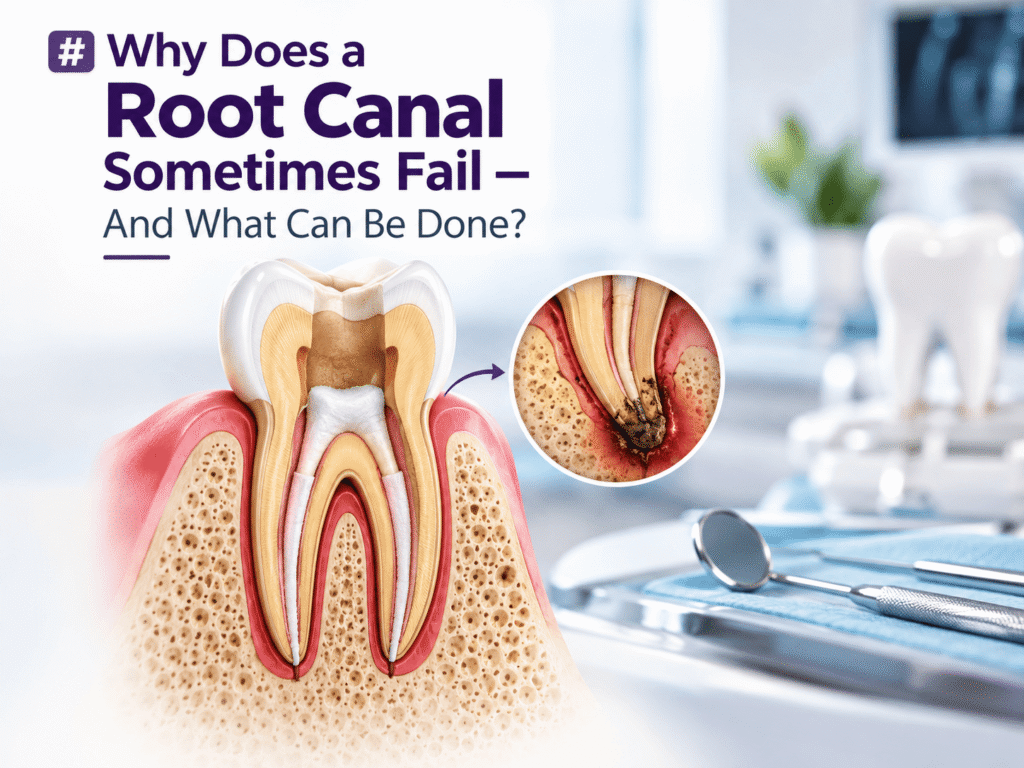
A patient once came to us and said something I hear quite often:
“Doctor, I have already done a root canal on this tooth. It was fine for some time, but now it has started hurting again. Do I have to remove the tooth?”
Not necessarily.
A root canal-treated tooth developing pain or infection does not automatically mean that the tooth has to be extracted. The first question we need to answer is: Why did the root canal fail?
And that is where the diagnosis becomes more important than simply repeating the treatment.
Why Can a Root Canal Fail?
Root canal treatment is essentially an attempt to clean, disinfect, and seal a very complicated internal space inside the tooth. The problem is that teeth are not simple tubes.
They can have:
- Very narrow canals
- Curved canals
- Additional canals
- Canals that divide into multiple branches
- Calcified or blocked canals
- Untreated anatomy that may not be visible on a routine X-ray
Sometimes the original treatment has missed one of these areas. In other situations, the canal may have been treated properly, but the tooth develops a new problem later because of leakage, a defective restoration, new decay, or a crack.
So when a patient says “my root canal has failed,” I don’t immediately assume that the previous dentist did something wrong. I first want to understand what actually happened inside that tooth.
The Most Common Reason: An Untreated Canal
This is particularly important in molars. A tooth may appear to have three canals on an ordinary X-ray, while clinically it may have another canal hidden between them. If that canal contains infected tissue or bacteria and is not treated, the infection can persist.
This is one reason why magnification and proper illumination can make a significant difference during root canal treatment.
At Sanjivan Dental, we routinely use a dental operating microscope for difficult endodontic procedures. It allows us to work with much greater visual control when searching for additional canals, calcifications, broken instruments, and other complexities.
But Sometimes the Problem is Not the Root Canal Itself
A previously treated tooth can hurt for reasons other than persistent infection inside the canal:
- 1. A Crack or Fracture: A cracked tooth can produce symptoms that sometimes look like a failed root canal. If there is a vertical root fracture, simply doing another root canal will not solve the fundamental problem. (Read more: When a Cracked Tooth Can Be Saved)
- 2. Leakage from the Restoration: Even a well-cleaned root canal can be compromised if the tooth is not properly sealed afterward. The crown or restoration is therefore an important part of protecting the treated tooth.
- 3. New Decay: A tooth that has already undergone root canal treatment can develop recurrent decay around an old filling or crown.
- 4. Complex Anatomy: Some infections persist because the internal anatomy is exceptionally complicated.
- 5. Persistent Infection Outside the Root: Occasionally, the problem may involve the tissues around the root rather than simply an inadequately treated canal.
This is why “just do another root canal” is not always the correct answer.
How CBCT Imaging Changes the Diagnosis
For a difficult retreatment case, I don’t want to rely only on a conventional two-dimensional X-ray. A CBCT (3D) scan gives us a three-dimensional understanding of:
- The number and shape of canals
- Missed anatomy
- The extent of bone destruction
- The position of the roots, perforations, or suspected fractures
- Previous treatment complications
However, CBCT should not be taken simply because it is available—the scan must answer a specific clinical question. That is how I prefer to use technology in dentistry.
Can a Failed Root Canal Be Retreated?
In many cases, yes.
If the tooth has a reasonable remaining structure and there is no condition that makes it hopeless, nonsurgical root canal retreatment may be considered.
During retreatment, the old filling material is removed, the canals are re-examined, missed anatomy is searched for, and the canals are disinfected and sealed again. If the case allows, procedures like a Single Visit Root Canal Treatment can also be evaluated based on the infection level.
Sometimes the challenge is an old post, a separated instrument, calcification, or severely altered canal anatomy. These cases require precise planning and specialized tools.
And Sometimes Retreatment is Not Enough
There are situations where conventional retreatment may not be the best option. Depending on the case, treatment pathways could involve:
$$\text{Nonsurgical Retreatment} \longrightarrow \text{Surgical Endodontic Treatment} \longrightarrow \text{Extraction \& Replacement}$$
The important point is that these are individual decisions based on the condition of the tooth, not a fixed sequence that every patient has to follow.
If the tooth is structurally unsalvageable, the correct decision may actually be to remove it and look into replacement options like Dental Implants vs Dentures or evaluate How Long Does a Dental Implant Last?.
Saving a tooth is valuable—but saving a hopeless tooth at any cost is not good dentistry.
Three Questions We Answer Before Treatment
When someone comes to me with a failed root canal, I don’t start treatment immediately. We first answer three crucial questions:
- What went wrong?
- Can we correct it?
- Is the tooth structurally capable of surviving after correction?
Only after answering these questions do we decide between retreatment, surgery, or extraction. That is the difference between repeating a procedure and treating the actual problem.
Root Canal Retreatment at Sanjivan Dental
Our approach to complicated root canal cases combines thorough clinical examination, appropriate 3D imaging, precision microscope magnification, and careful treatment planning.
The objective is not simply to perform another root canal. The objective is to determine whether your natural tooth can be predictably saved—and, when it can, to do that with as few unnecessary visits as reasonably possible.
Before deciding to remove a tooth, it is worth finding out whether there is still a predictable way to save it.