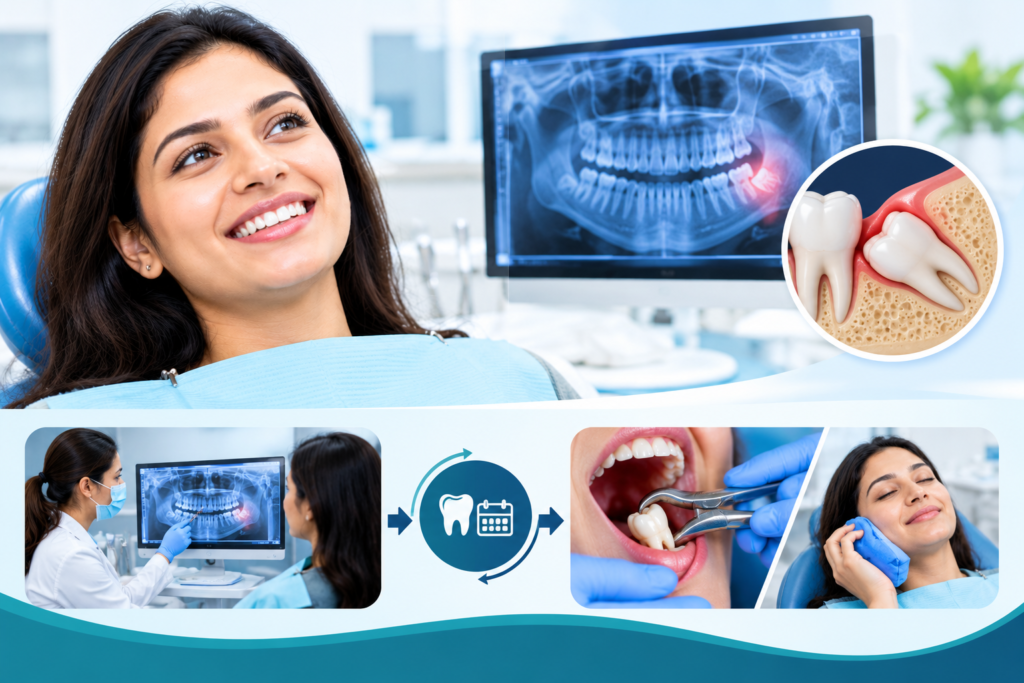
A common scenario brings patients to our clinic: persistent pain or food getting stuck near a lower back tooth. Most assume it is simply a problematic wisdom tooth.
However, diagnostic 3D imaging often reveals a more complex issue. An impacted lower wisdom tooth (third molar) tilted against the adjacent second molar creates a hard-to-clean trap. Over time, bacteria destroy the back wall of the second molar, leading to deep decay and pulp infection.
[ Impacted 3rd Molar ] ──(Presses Against)──► [ Back Wall of 2nd Molar ] ──(Plaque Trap)──► [ Deep Decay & Root Canal Infection ]
Suddenly, a single problem requires a multi-step solution:
- Root canal therapy for the infected second molar
- Crown preparation to protect the saved tooth
- Surgical removal of the impacted wisdom tooth
- Surgical site disinfection and suturing
- Follow-up care and final crown placement
Traditionally, this meant 5 to 6 separate appointments spread over several weeks. At Sanjivan Dental, we approach complex cases differently: Maximum clinical treatment in minimum visits—without compromising safety or quality.
Why Consolidate Procedures Into Fewer Visits?
Dividing treatment across multiple weeks creates unnecessary stress, repeated leave from work, multiple rounds of local anesthesia, and prolonged post-treatment recovery windows.
When clinically appropriate, combining procedures during a single, well-planned appointment offers clear advantages:
- One Episode of Anesthesia: Multiple issues are corrected under a single local anesthesia window.
- Minimized Disruption: Saves valuable time for busy professionals, parents, and traveling patients.
- Targeted Recovery: Concentrates post-procedure healing into a single timeframe rather than dragging it out over months.
- Rational Medication Use: Decreases the need for repetitive courses of post-operative medications.
The 2-Visit Treatment Journey
Instead of spreading care over six separate visits, selected cases can be streamlined into two structured sessions:
┌─────────────────────────────────────────────────────────────────────────┐
│                                VISIT 1                                  │
├─────────────────────────────────────────────────────────────────────────┤
│  • 3D CBCT Imaging & Diagnostic Mapping                                 │
│  • Root Canal Treatment of the 2nd Molar                                │
│  • Core Build-up & Crown Preparation                                    │
│  • Surgical Extraction of the Impacted 3rd Molar                        │
│  • Surgical Area Disinfection & Suturing                                │
└────────────────────────────────────┬────────────────────────────────────┘
                                     │
                                     ▼
                            [ Healing Window ]
                                     │
                                     ▼
┌─────────────────────────────────────────────────────────────────────────┐
│                                VISIT 2                                  │
├─────────────────────────────────────────────────────────────────────────┤
│  • Clinical Healing Evaluation                                          │
│  • Suture Removal                                                       │
│  • Digital Impression / Final Crown Placement                           │
└─────────────────────────────────────────────────────────────────────────┘
Technology That Makes Minimum-Visit Dentistry Possible
Accelerating treatment safely requires advanced diagnostic tools, digital precision, and integrated clinical workflows:
| Technology | Clinical Purpose | Patient Benefit |
| 3D CBCT Scans | Complete structural view of root anatomy, nerve proximity, and bone density. | Eliminates surprises during surgery and root canal therapy. |
| Rotary Endodontics | Efficient, highly precise root canal cleaning and shaping systems. | Enables single-session root canal completion. |
| Digital Intraoral Scanners | Captures 3D optical impressions of prepared teeth. | Replaces uncomfortable physical impression trays and speeds up lab work. |
| Piezosurgery / Modern Instruments | Controlled, minimally invasive bone removal techniques. | Reduces surgical trauma, swelling, and post-operative discomfort. |
Efficiency Without Compromise
It is important to emphasize that minimum-visit dentistry is not rushed dentistry.
Completing treatment in fewer appointments requires extensive pre-procedure planning behind the scenes. If severe active infection, complex medical histories, or compromised bone structure require a staged approach, we prioritize biological healing over speed every time.
Our goal is not simply to finish fast—it is to deliver advanced, precise, and lasting care in the minimum number of visits your biology safely allows.
Frequently Asked Questions
Does combining root canal treatment and wisdom tooth surgery increase pain?
No. Because both procedures are performed under local anesthesia during the same session, you experience the procedure comfortably. Post-operative management is combined into a single recovery window.
Will I need antibiotics after a combined procedure?
Medications are prescribed based on strict clinical necessity rather than routine practice. Combining procedures often avoids repetitive courses of post-treatment drugs.
Can every impacted wisdom tooth case be completed in 2 visits?
Most suitable cases can be managed in this consolidated workflow, but severe infections or complex anatomy may require additional healing steps. A 3D CBCT evaluation determines the best plan for your case