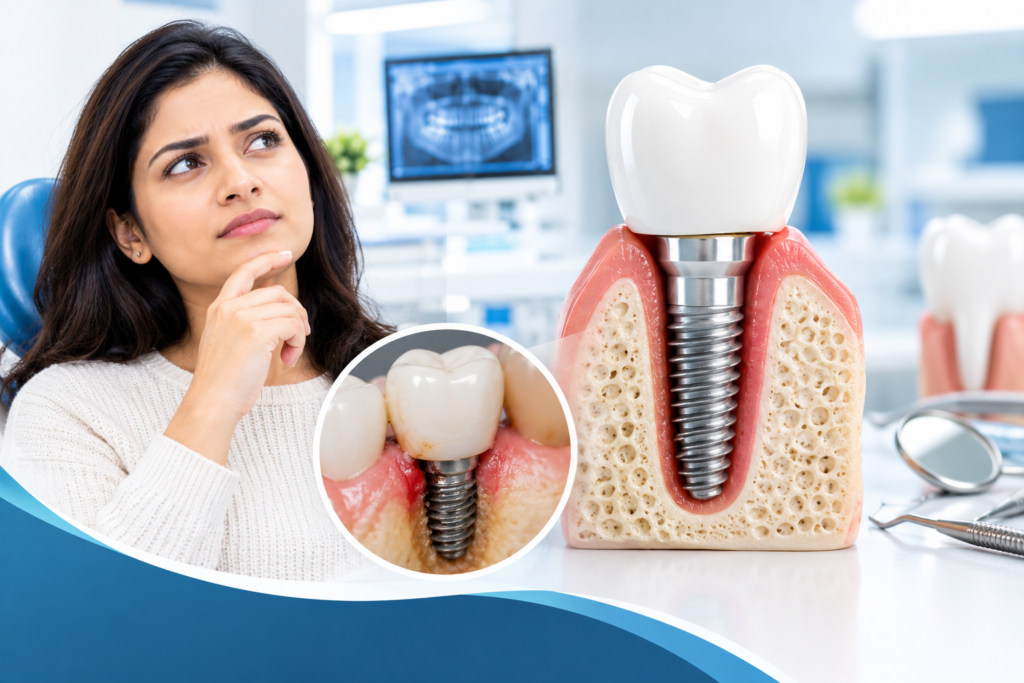
A patient once asked me a deceptively simple question:
“Doctor, if the implant itself is high quality, how can it fail?”
It is a completely reasonable question. Patients often assume that an implant failure means the titanium post itself was defective. In reality, an implant is only one component of a much larger, complex system.
The long-term success of an implant depends on a combination of factors:
[ Precision Planning ] ──► [ Bone Quality & Surgery ] ──► [ Prosthetic & Bite Design ] ──► [ Hygiene & Maintenance ]
At Sanjivan Dental, we don’t start implant cases by asking, “Which brand should we place?” We ask: “Is an implant the right treatment here, and how must the final tooth be designed to function safely?”
What Does “Implant Failure” Actually Mean?
Implant failure falls into two distinct categories based on timing:
- Early Failure (Integration Issue): The implant fails to fuse with the jawbone (osseointegration) during the initial healing phase.
- Late Failure (Biological or Mechanical): The implant successfully integrates and functions for years, but later develops problems due to infection, bone loss, or excessive force.
Understanding when and why an issue develops is essential for addressing it effectively.
7 Reasons a Good Dental Implant Can Fail
1. Poor Treatment Planning
An implant should never be placed simply where a gap in the bone exists. The foundation must be planned backward from the final tooth’s position.
Final Tooth Function & Aesthetics ──► Prosthetic Design ──► Precision Implant Position
Placing an implant without evaluating adjacent teeth, nerve locations, sinus cavities, and the patient’s bite increases the risk of long-term failure.
2. Insufficient Bone Density or Volume
When a tooth is missing for years, the jawbone in that area naturally resorbs over time. If an implant is placed into inadequate or low-density bone without grafting or site preparation, it cannot achieve stable integration.
Options to correct this include:
- Bone augmentation (grafting)
- Sinus lift / sinus augmentation
- Modified implant design or alternative positioning
3. Infection (Peri-Implantitis)
While an implant cannot get a cavity, the living tissues surrounding it can become infected.
- Early Infection: Occurs during initial healing and halts bone fusion.
- Peri-Implant Disease: Inflammation and progressive bone loss around a previously stable, working implant.
4. Smoking & Systemic Factors
Patient-specific health factors directly influence bone healing and tissue health.
| Risk Factor | Biological Impact |
| Smoking | Constricts blood vessels, impairs healing, and significantly elevates complication risks. |
| Uncontrolled Systemic Conditions | Conditions like uncontrolled diabetes impair immune response and bone integration. |
| Poor Hygiene | Allows plaque accumulation around the implant collar, triggering soft tissue inflammation. |
5. Excessive Biting Forces & Occlusal Trauma
Unlike natural teeth, implants do not have a flexible periodontal ligament. They are fused directly to the bone, meaning they absorb raw bite forces without a built-in shock absorber.
Heavy biting forces, teeth grinding (bruxism), or an improperly balanced bite can cause mechanical overload, loosening components or destroying supporting bone.
6. Poor Oral Hygiene & Lack of Maintenance
A common misconception is: “It’s an artificial tooth, so I don’t need to brush or floss it as carefully.”
While the implant body itself will not decay, plaque buildup around the restoration triggers inflammation, bone loss, and ultimate failure. Implants demand the same daily care as natural teeth.
7. Choosing the Wrong Treatment Option
Sometimes, the best choice isn’t an implant at all. If a natural tooth can be predictably saved with root canal therapy and a proper restoration, saving the natural structure is often preferable. Conversely, attempting to hold onto a hopeless tooth for too long can destroy remaining bone, making future implant placement far more difficult.
Does the Implant Brand Determine Success?
Patients frequently ask: “Which brand is the best?”
While manufacturing standards, design, and clinical research matter, even the most expensive implant brand cannot overcome bad planning, poor hygiene, or improper bite mechanics. Think of it like a high-performance car: with a poor driver and no oil changes, even a luxury vehicle will break down.
At Sanjivan Dental, we combine 3D CBCT imaging with digital restoration planning to position implants with absolute precision. By evaluating bone density and bite forces beforehand, we ensure the entire system—implant, bone, crown, and bite—works seamlessly.
What Should You Do If Your Implant Feels Loose?
Do not wait. Contact your dentist immediately. A loose sensation could indicate:
- A simple loose screw or abutment component
- Mechanical wear of the crown
- Active infection or bone loss
- A failure of bone integration
Early evaluation can often save the restoration before irreversible damage occurs.
Frequently Asked Questions
Can a dental implant last for life?
Implants offer long-term stability, but no medical device is guaranteed forever. Longevity depends heavily on oral hygiene, health factors, and routine dental checkups.
Is implant failure always painful?
No. Complications like bone loss or peri-implantitis can progress quietly without significant pain, which is why periodic X-rays and maintenance checkups are essential.
Can a failed implant be replaced?
In most cases, yes. Once the underlying cause of failure is diagnosed and the surrounding bone tissue is treated or grafted, a new implant can usually be placed.
Is a CBCT scan required for every implant?
While basic cases may require simpler diagnostics, 3D CBCT scans are recommended for precise placement, multi-implant planning, and avoiding crucial anatomical structures like nerves.