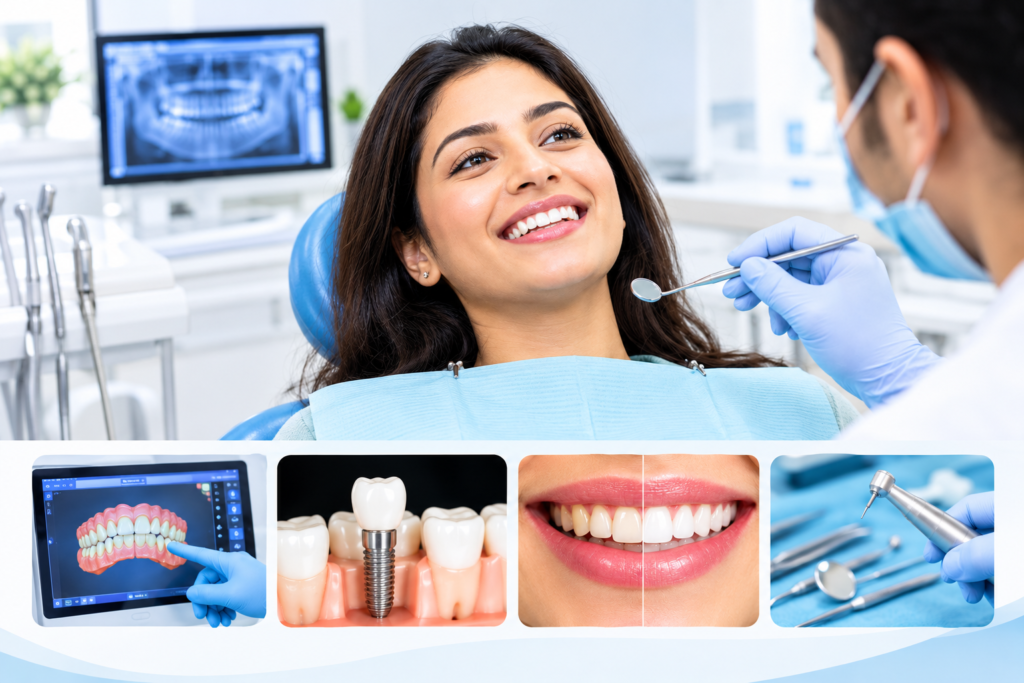
When patients hear the words “full-mouth rehabilitation,” their immediate reaction is often:
“Doctor, how many months is this going to take?”
That concern is completely understandable. If you have multiple broken teeth, worn crowns, missing teeth, cavities, or several teeth requiring root canals, treatment can sound overwhelming. Historically, it meant dozens of appointments spread over several months.
However, with modern digital dentistry and precise treatment planning, selected cases can now be completed in significantly fewer visits. At Sanjivan Dental, we routinely plan complex cases to maximize efficiency—completing the highest volume of work in the minimum number of visits without compromising biological health or technical precision.
What Exactly Is Full-Mouth Rehabilitation?
Full-mouth rehabilitation is not simply “putting crowns on all the teeth.” It is a comprehensive, system-wide treatment plan designed to restore the function, health, appearance, and structural stability of your entire mouth.
Depending on your specific needs, treatment may integrate:
- Root canal treatment
- Dental crowns and bridges
- Dental implants and replacement of missing teeth
- Restoration of worn or fractured teeth
- Occlusal rehabilitation (correction of an improper bite)
- Gum therapy and tooth-colored restorations
- Esthetic smile alignment
Every component must work as a single cohesive unit. A beautifully crafted crown will fail if the bite force is distributed incorrectly, and an implant will fail if placed without considering the overall bite.
Comprehensive planning is far more critical than the execution of any single procedure.
Why Do Full-Mouth Cases Traditionally Take So Many Visits?
A conventional workflow treats individual teeth in isolation:
| Stage | Conventional Process | Sanjivan Digital Workflow |
| Diagnostics | Multiple visits for separate manual impressions, basic X-rays, and physical models. | Single-visit digital intraoral scan, photos, and 3D CBCT imaging. |
| Treatment | One or two teeth treated per appointment over weeks or months. | Coordinated, multi-procedure block sessions under local anesthesia. |
| Laboratory | Physical shipping of putty impressions, higher risk of remakes and delays. | Immediate digital CAD/CAM transmission directly to the lab team. |
| Delivery | Individual try-ins and piecemeal cementation across multiple appointments. | Single-session precision try-in, bite verification, and final delivery. |
For patients managing busy work schedules or traveling from other cities, multiplying appointments becomes a massive hurdle. Our principle at Sanjivan Dental is straightforward: Do more per visit, but never cut corners.
How Modern Dentistry Compresses Time Without Compromising Quality
Completing extensive care in 2–3 visits relies entirely on meticulous preparation and digital integration:
1. Digital Diagnostics Before Touching a Tooth
Using 3D Cone Beam Computed Tomography (CBCT) and intraoral digital scanners, we map out your entire anatomy—bone density, nerves, roots, and occlusion—before treatment even starts. We map the entire journey digitally before taking a single physical step.
2. Elimination of Physical Impressions
Intraoral scanners capture your teeth and bite with sub-millimeter digital accuracy. This eliminates uncomfortable impression materials, reduces laboratory turn-around times, and improves fit precision.
3. Procedure Coordination
Instead of treating teeth sequentially across separate months, complex procedures are combined into structured clinical phases:
Crucial Note: A 2–3 visit workflow is a clinical possibility for suitable cases, not a blanket promise for every patient.
The Behind-the-Scenes Investment
When a patient sits in the chair for a coordinated two-hour appointment, they are seeing only a fraction of the work. Behind the scenes, the dental team spends extensive hours:
- Analyzing 3D CBCT bone and airway volumes
- Digitally designing restorations (CAD/CAM)
- Aligning implant trajectories with the final bite model
- Coordinating step-by-step sequencing with the dental laboratory
Fewer visits do not mean faster or cheaper dentistry—it means more intensive prep work before you sit in the chair.
Candidates vs. Non-Candidates for Accelerated Care
Ideal Candidates:
- Clear diagnosis with healthy underlying support structures
- Medically fit for longer clinical sessions
- Absence of active, widespread periodontal (gum) disease
- Predictable bite dynamics that can be digitally mapped
When Treatment MUST Be Staged (Respecting Biology):
- Active, severe periodontal disease requiring extended healing
- Uncontrolled oral infections or extensive bone grafting needs
- Temporomandibular Joint (TMJ) disorders requiring bite stabilization over time
- Highly complex bone augmentation prior to implant placement
In these situations, rushing compromises the long-term success of the treatment. Good dentistry always respects biology.
Frequently Asked Questions
Is full-mouth rehabilitation painful?
No. With modern local anesthetics, micro-invasive techniques, and tailored post-procedure protocols, extensive treatments are surprisingly comfortable.
Can all my teeth be fixed in a single day?
While multiple steps can be grouped into one day, completing a full-mouth rehabilitation in 24 hours is rarely clinically advisable. Tissues need time to adapt and integrate.
Is a CBCT 3D scan mandatory for everyone?
CBCT scans are utilized when 3D structural data is clinically required—particularly for implant positioning, bone evaluation, and complex root structures.
Do you accept patients traveling from outside Ahilyanagar/Ahmednagar?
Yes. We regularly design consolidated treatment schedules specifically for out-of-town patients to minimize travel and waiting periods without sacrificing quality.