By Dr. Durga Prasad Hiwale, Sanjivan Dental
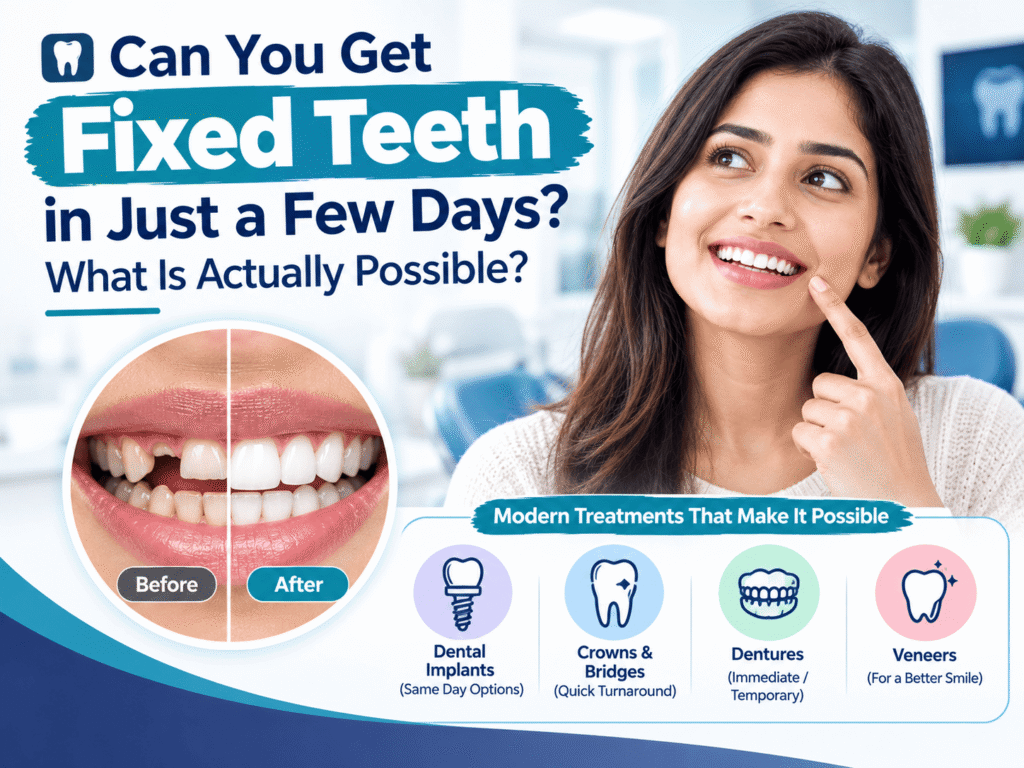
“Doctor, I don’t want to wear a removable denture for months. Is there a way I can get fixed teeth quickly?”
This is one of the most common questions we hear from patients who have lost several teeth—or who are facing the loss of teeth that are already badly damaged.
The short answer is: In selected cases, yes.
But there is an important difference between “getting teeth quickly” and “doing treatment properly.” Fast dentistry should never mean rushed dentistry.
At Sanjivan, our philosophy has always been maximum appropriate treatment in minimum practical visits. The key word is appropriate.
Why Does Conventional Implant Treatment Sometimes Take Months?
Traditional implant treatment may involve several stages:
- Tooth removal or management of the existing teeth
- Healing
- Bone assessment or augmentation when required
- Implant placement
- Implant healing and integration
- Final prosthetic teeth
This can take several months in some patients, and that approach is still appropriate for many situations. But it is not the only possible treatment pathway.
Advances in implant planning, surgical protocols, and immediate loading have made it possible to provide fixed teeth much earlier in carefully selected cases.
What Does “Immediate Fixed Teeth” Actually Mean?
It does not mean that the final permanent teeth are magically made and inserted immediately after surgery.
In many full-mouth cases, the process involves:
$$\text{Diagnosis} \longrightarrow \text{CBCT Planning} \longrightarrow \text{Implant Placement} \longrightarrow \text{Immediate Provisional Fixed Teeth} \longrightarrow \text{Healing} \longrightarrow \text{Definitive Prosthesis}$$
The patient can therefore leave with fixed provisional teeth rather than a removable denture. The final prosthesis is usually provided after the appropriate healing and evaluation period. That distinction is important.
But What If the Patient Has Very Little Bone?
This is where treatment planning becomes particularly important. A patient who has lost teeth many years ago may have severe bone resorption.
In some patients, conventional implants can be placed using the available bone. In others, additional procedures may be required.
And in severely resorbed cases, depending on the anatomy, advanced implant strategies may be considered. These can include combinations of:
- Strategically positioned implants
- Tilted/angled implants
- Pterygoid implants
- Zygomatic implants
- Implants placed in areas of available stronger bone
The objective is not simply to put in as many implants as possible—the objective is to create a stable foundation for the fixed teeth.
Why CBCT Planning Matters So Much
For a full-mouth rehabilitation, I don’t want to look at each missing tooth independently. I want to see the entire three-dimensional situation.
A CBCT scan helps us assess:
- Available bone
- Sinus anatomy
- Nerve position
- Cortical plates
- Previous implants
- Remaining teeth
- Areas of severe resorption
- Possible implant positions
But there is another equally important aspect: Where should the final teeth be? The implants should be planned with the final prosthesis in mind. This is why complex implant dentistry is as much about planning as it is about surgery.
Can Every Patient Get Fixed Teeth in 24 Hours?
No. And I would be very cautious of anyone promising that without examining the patient.
Immediate fixed teeth depend on several factors, including:
- Bone availability
- Implant stability
- Presence of infection
- Condition of remaining teeth
- Systemic health factors
- Bite and occlusion
- Quality of the planned prosthesis
- Ability to maintain oral hygiene
- Overall treatment plan
Sometimes immediate loading is appropriate; sometimes it isn’t. The patient’s anatomy—not the advertisement—should decide the timeline.
One of the Biggest Advantages: Fewer Treatment Interruptions
Imagine a patient with multiple failing teeth. Traditionally, treatment may involve multiple appointments spread over a long period.
For some patients, that is perfectly manageable. For others—especially working professionals, people travelling from other cities, or patients who are anxious about repeated dental visits—the number of visits becomes a significant consideration.
This is where our minimum-visit philosophy becomes useful. Before starting treatment, we try to organize the diagnosis, imaging, surgical planning, and prosthetic requirements so that unnecessary appointments are avoided.
It doesn’t mean cutting corners—it means planning the treatment properly before starting it.
What About a Patient Who Has Almost No Upper Jaw Bone?
These are among the most challenging cases. A conventional implant solution may not always be possible without extensive bone augmentation.
But in selected patients with severe maxillary resorption, advanced anchorage options—including zygomatic and pterygoid implants—may be considered.
These procedures require careful CBCT analysis and advanced surgical planning. They are not suitable for everyone, and they should not be presented as a shortcut simply because they can reduce the need for conventional bone augmentation.
Fast Treatment Still Needs Time
This sounds contradictory, but it is actually one of the most important principles:
The surgery may be completed quickly. The planning should not be rushed.
A complex full-mouth case may involve:
- Clinical photographs
- Detailed clinical examination
- 3D CBCT scans
- Digital intraoral scans
- Prosthetic planning
- Implant positioning and surgical guide design
- Provisional prosthesis planning
A large amount of work happens before the patient sits in the dental chair for surgery. That preparation is what makes a minimum-visit approach possible.
The Sanjivan Approach
Our philosophy is not: “Do everything fast.”
It is: “Do everything that is required, but avoid unnecessary visits and unnecessary delays.”
For suitable full-mouth cases, this can allow patients to receive fixed provisional teeth much sooner than they may have expected. But the exact timeline depends entirely on the patient’s condition and treatment plan.
Sometimes it can be very short. Sometimes additional healing or procedures are necessary. There is no honest one-size-fits-all timeline in implant dentistry.
If You Have Been Told That You Need Dentures for Months…
Don’t assume that is your only option. At the same time, don’t assume that an advertisement promising “fixed teeth in 24 hours” automatically applies to you.
Get the case properly evaluated and ask these important questions:
- How much bone do I have?
- Where can implants safely be placed?
- What type of fixed teeth will I receive initially?
- What will happen after healing?
- Is bone grafting necessary?
- What happens if conventional implants are not possible?
These questions are much more useful than simply asking: “How fast can I get my teeth?”
Because Fast Should Mean Planned — Not Rushed
At Sanjivan Dental, our goal is to combine advanced diagnosis, CBCT-based planning, surgical precision, and prosthetic planning to complete appropriate treatment in the minimum practical number of visits.
For some patients, that may mean fixed teeth very quickly. For others, a longer staged approach may be safer and more predictable.
The right treatment is not the fastest treatment—it is the treatment that achieves the right result without unnecessary delay.