By Dr. Durga Prasad Hiwale, Sanjivan Dental
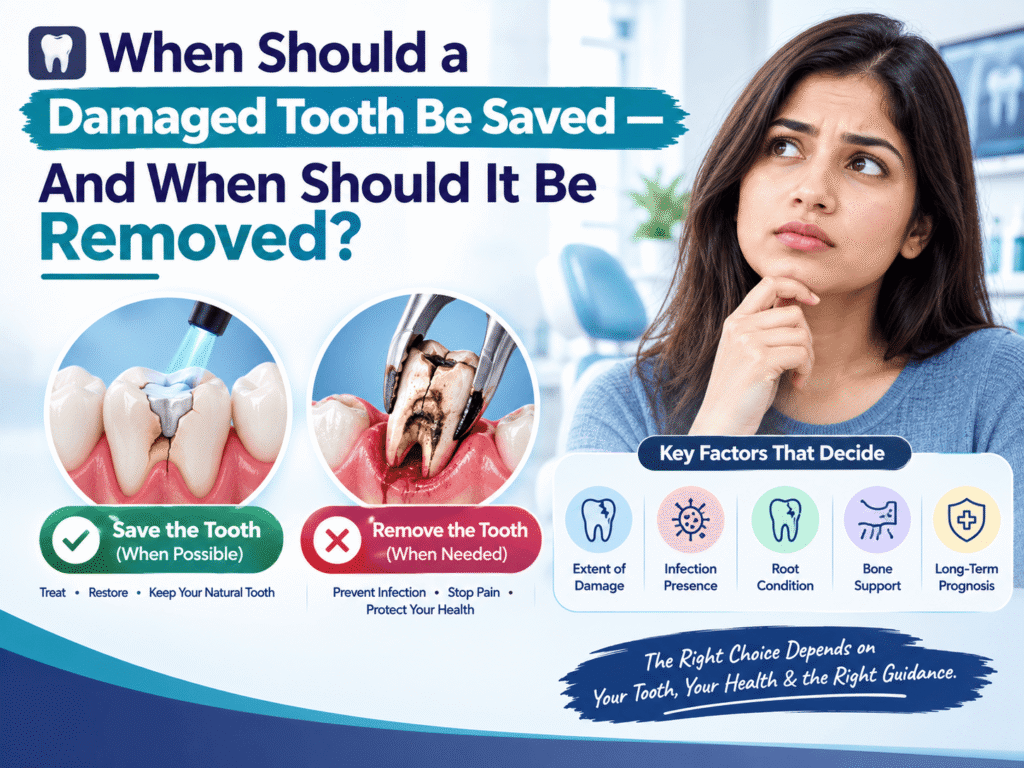
One of the most difficult questions in dentistry is also one of the simplest:
“Doctor, can you save this tooth?”
And sometimes the answer is yes. But sometimes, despite our best efforts, the tooth cannot be predictably saved.
I think patients deserve to know the difference. Saving a natural tooth is valuable—but trying to save a tooth that has no reasonable prognosis can sometimes delay the treatment that the patient actually needs.
A Badly Damaged Tooth Does Not Automatically Mean Extraction
I have seen patients come to us after being told: “This tooth is broken. Remove it and put an implant.”
But a broken tooth can mean many different things. It may have:
- A large cavity
- A missing portion of the crown
- An old leaking filling
- Extensive decay
- An infection
- A previous failed root canal
- A fracture
- Loss of supporting bone
These situations may look similar to a patient, but they are completely different clinically. That is why I don’t make the decision based only on how much of the visible tooth is missing.
The First Question: How Much Healthy Tooth Is Left?
A tooth can lose a surprisingly large amount of its crown and still sometimes be restored. If enough healthy tooth structure remains above the gumline, we may be able to rebuild it.
Depending on the situation, treatment may involve:
$$\text{Root Canal Treatment} \longrightarrow \text{Core Build-up} \longrightarrow \text{Crown}$$
Sometimes additional procedures are required to expose or preserve sound tooth structure.
The important question is not: “How much of the tooth is missing?”
It is: “Is there enough healthy tooth structure remaining to support a predictable restoration?”
What If the Tooth Is Infected?
An infected tooth does not automatically need to be removed.
If the tooth has adequate remaining structure and the roots are suitable, root canal treatment can eliminate the infected tissue from inside the tooth. In selected cases, even a tooth that looks quite badly damaged externally can be restored after proper endodontic treatment.
This is one reason I prefer to evaluate the tooth carefully before recommending extraction.
What About a Previous Failed Root Canal?
This is another situation where patients are sometimes told: “The root canal has failed, so the tooth has to come out.”
Again, not necessarily. A failed root canal may have a treatable cause:
- A missed canal
- Persistent infection
- Inadequate previous cleaning
- Leakage
- Complex anatomy
- A separated instrument
- Other treatment complications
Depending on the condition of the tooth, retreatment may still be possible. A CBCT and microscopic examination can sometimes reveal information that isn’t obvious on a conventional X-ray.
A Problem I Take Very Seriously: Cracks
A tooth with a fracture is a different situation.
A superficial crack in the crown may sometimes be managed. But a vertical root fracture can make the prognosis very different.
This is why I don’t want to perform repeated root canal treatments simply because a tooth hurts. Before deciding to retreat the tooth, we need to understand why it is failing.
- Sometimes the answer is infection.
- Sometimes the answer is a fracture.
And those require completely different treatment decisions.
What About a Tooth with Very Little Bone?
The tooth itself may be structurally sound but have inadequate periodontal support. If there has been significant bone loss, the question becomes: Can the supporting tissues be stabilized sufficiently to keep the tooth functional?
Again, there is no single answer. The amount and pattern of bone loss, mobility, periodontal condition, root anatomy, bite, and the patient’s ability to maintain oral hygiene all matter.
A tooth with some bone loss is not automatically hopeless. But severe loss of supporting structures can significantly affect its prognosis.
When Do We Consider Extraction?
There are situations where extraction becomes the more predictable choice. Examples can include:
- A tooth with an unfavourable vertical root fracture
- Severe structural destruction with insufficient sound tooth remaining
- Extensive decay extending beyond a level that can be predictably restored
- Certain advanced periodontal situations
- Severe infection combined with an unfavourable prognosis
- A tooth that cannot be predictably restored despite appropriate treatment
The key word is predictably. Dentistry is not about keeping a tooth at any cost. It is about choosing a treatment that has a reasonable chance of functioning well for the patient.
“But Doctor, I Want to Save My Natural Tooth.”
I understand that completely. Whenever a natural tooth can be predictably preserved, I generally prefer preservation over unnecessary extraction.
But I also explain something important to patients: Saving a tooth today is not the same as saving it for the next 20 years.
The prognosis matters. If a tooth has a very poor long-term outlook, spending a great deal of time and money repeatedly treating it may not be in the patient’s best interest. In that situation, extraction followed by a properly planned replacement may actually be the more responsible treatment.
This Is Where Clinical Experience Matters
There is no single number that tells us: “30% of the tooth is left → save it.” Real teeth don’t work like that.
Two teeth with apparently similar damage can have completely different prognoses:
- Tooth A (Worth Saving): Has good root support, adequate ferrule, favourable root anatomy, and manageable infection.
- Tooth B (Poor Candidate): Has a root fracture, extensive decay below the gumline, or severe bone loss.
The diagnosis has to come before the procedure.
What Happens If the Tooth Really Cannot Be Saved?
Extraction doesn’t mean the end of treatment. It means we move to the next question: How should the missing tooth be replaced?
Depending on the situation, options may include:
- Dental implant
- Fixed bridge
- Removable partial denture
- Other prosthetic solutions
When possible, I like to discuss tooth replacement before extraction. Removing a tooth changes the bone, soft tissues, and future implant possibilities. Sometimes the best implant planning begins before the tooth is removed.
Don’t Make the Decision from a Photograph
A patient may send me a photograph and ask: “Can this tooth be saved?”
A photograph can certainly be useful, but it cannot tell us everything. We may need:
$$\text{Clinical Examination} + \text{X-ray/CBCT} + \text{Periodontal Assessment} + \text{Bite Evaluation} + \text{Remaining Structure Assessment}$$
Only then can we give a meaningful prognosis.
Our Philosophy at Sanjivan Dental
At Sanjivan Dental, we don’t believe in extracting a tooth simply because it is difficult. But we also don’t believe in promising to save every tooth.
Our job is to find out whether the tooth is realistically salvageable:
- If it is, we try to preserve it with the appropriate treatment.
- If it isn’t, we explain why—and then plan the replacement properly.
Because sometimes the best dentistry is saving a tooth. And sometimes the best dentistry is knowing when not to save one.