By Dr. Durga Prasad Hiwale, Sanjivan Dental
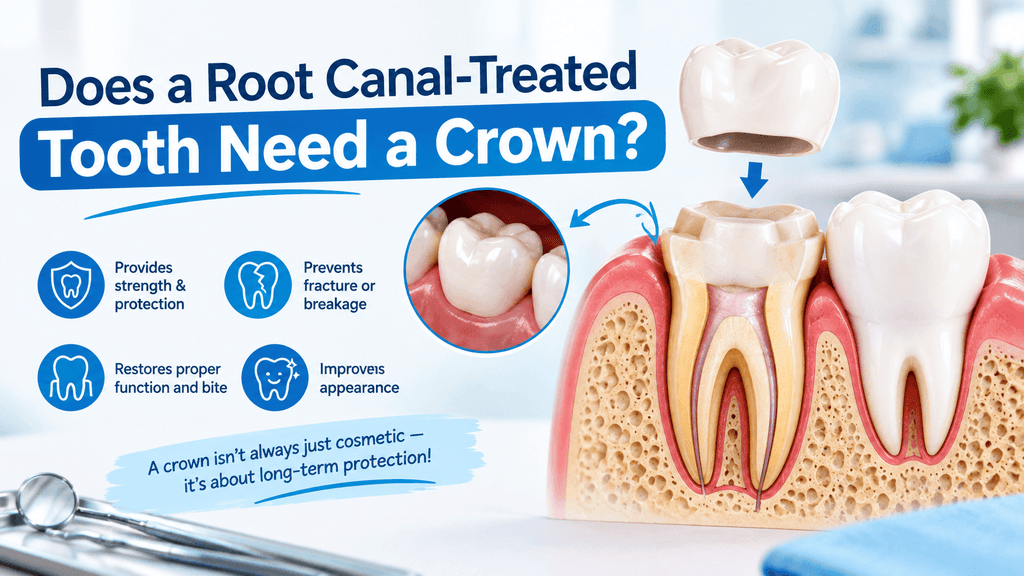
“Doctor, my root canal is completed. Now do I have to put a crown?”
This is one of those questions where the answer is not simply yes or no. A common belief is: “Once a tooth has undergone root canal treatment, it must have a crown.”
But in my clinical practice, I don’t look at it that way. The need for a crown depends on the tooth, how much healthy structure remains, how it functions, and what forces it will have to withstand.
A front tooth and a heavily damaged molar are not the same situation.
Root Canal Treatment Does Not Automatically Mean the Same Restoration
When we perform a root canal, the infected or inflamed tissue inside the tooth is removed, and the canal system is cleaned, disinfected, and sealed.
But after that, we still have another important question: How should we restore the tooth?
This is where many treatment plans become unnecessarily routine. Instead of asking: “Does every root canal tooth need a crown?” I prefer asking: “What restoration will adequately protect this particular tooth while preserving as much healthy tooth structure as possible?”
Front Teeth Are Different From Back Teeth
Consider an anterior (front) tooth that has undergone root canal treatment because of trauma or infection. If most of the natural tooth structure is still intact, placing a full crown may not always be necessary. In selected cases, a conservative composite restoration can restore the tooth while preserving more natural structure.
The situation changes considerably when we move to a molar:
- A molar receives substantial chewing forces.
- If it has already lost a large amount of tooth structure because of decay, an old filling, a fracture, or the access required for treatment, simply filling the access cavity may not provide sufficient protection.
- In such cases, coronal coverage becomes much more important.
The Real Issue: Remaining Tooth Structure
This is probably the most important point. A root canal does not make a tooth automatically weak. What often makes the tooth vulnerable is the loss of tooth structure that occurred because of decay, fracture, previous restorations, and the treatment required to access the canals.
So I evaluate:
- How much healthy tooth remains?
- Where is that healthy tooth structure?
- Is there a crack?
- How much chewing force will the tooth receive?
- What is the patient’s bite like?
- Can the remaining structure support the planned restoration?
Only then do I decide how much coverage is appropriate.
Does Every Posterior Tooth Need a Full Crown?
Not necessarily. There are situations where a conservative posterior restoration may be appropriate.
Depending on the remaining tooth structure and the clinical situation, options can include:
- An inlay
- An onlay
- A tabletop-type restoration
- Partial cuspal coverage
- A conventional crown
The objective is not to put the largest possible restoration on the tooth—it is to provide the amount of protection the tooth actually requires. This is particularly important in modern restorative dentistry, where preserving healthy tooth structure is a major consideration.
What If the Tooth Has a Large Crack?
Then the decision becomes more complex.
A cracked molar that has undergone root canal treatment may need cuspal protection to reduce the risk of further fracture. But before restoring it, we need to understand how far the crack extends and whether the tooth is actually restorable.
Putting a beautiful crown over a tooth with an unfavourable fracture does not solve the underlying problem. This is another reason why diagnosis should come before restoration.
Why I Don’t Believe in “Crown for Every RCT”
There is a simple reason: dentistry should be individualized.
- If a relatively intact anterior tooth can be predictably restored conservatively, unnecessarily reducing more tooth structure to make a crown may not be the philosophy I would choose.
- On the other hand, if a heavily compromised molar is left without adequate protection, we may be exposing the patient to an avoidable fracture.
Neither extreme is universally correct:
$$\text{“Every RCT tooth must have a crown.”} \quad \text{vs.} \quad \text{“A crown is never necessary after RCT.”}$$
Sometimes the Crown Is Not the First Priority
Another important consideration is the timing of the final restoration. If a tooth has extensive infection, significant structural loss, or other complications, we first need to make sure the underlying problem has been appropriately treated.
A crown is not a substitute for:
- Proper root canal treatment
- Adequate disinfection
- A good coronal seal
- Management of cracks
- Periodontal health
The restoration is part of the complete treatment—not the treatment itself.
At Sanjivan, We Try to Preserve What Is Healthy
This is an important part of our conservative dentistry philosophy. Our goal isn’t: “How can we put a crown on this tooth?” It is: “How can we restore this tooth predictably while preserving as much healthy natural structure as possible?”
- For one patient, that may mean a composite restoration.
- For another, it may mean an onlay or other partial coverage.
- For a heavily damaged posterior tooth, a crown may be the appropriate choice.
The treatment should follow the condition of the tooth, not a fixed formula.
So, Does Your Root Canal-Treated Tooth Need a Crown?
Sometimes yes. Sometimes no.
It depends primarily on the amount and location of remaining tooth structure, the tooth’s function, cracks or fractures, and the type of forces it will experience.
If someone tells you: “Root canal means crown. Every time.”
Ask one more question: “Why does my tooth need this particular restoration?”
A good treatment plan should be able to answer that. Because after saving a natural tooth, the next goal should be simple: protect what remains—without unnecessarily sacrificing what is healthy.