By Dr. Durga Prasad Hiwale, Sanjivan Dental
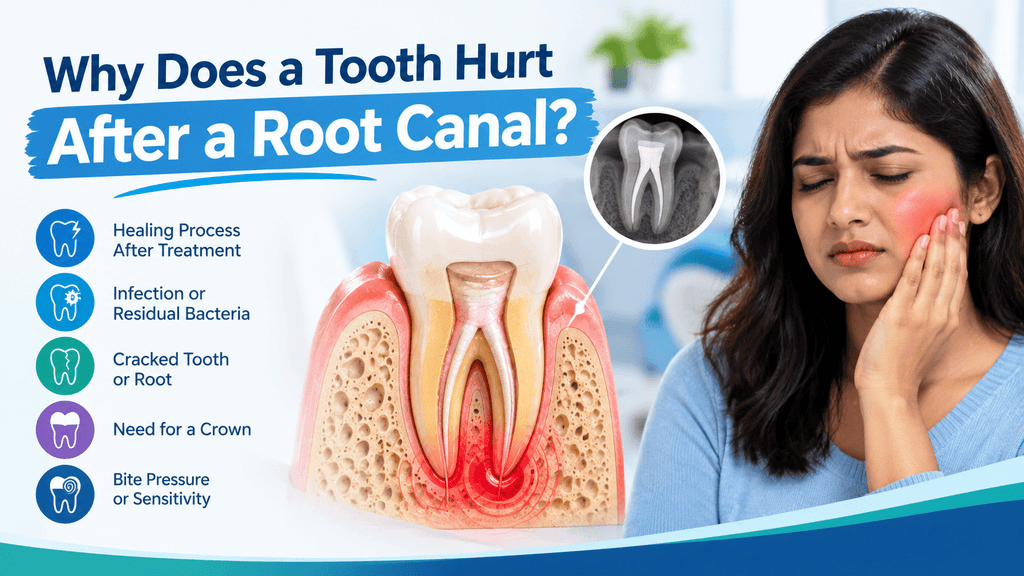
One of the most confusing experiences for a patient is this:
“Doctor, you told me the root canal is done. Then why does my tooth still hurt?”
It is a very natural question. After all, if the infected tissue inside the tooth has been removed, shouldn’t the pain disappear immediately?
Not always. A root canal treats the inside of the tooth, but the tissues around the root can remain inflamed for some time. And that is where much of the confusion comes from.
Pain After a Root Canal Does Not Automatically Mean Failure
During a root canal, we clean and disinfect the canal system. But before treatment, infection and inflammation may already have affected the tissues surrounding the root. Those tissues need time to settle.
So a patient may experience:
- Mild tenderness while biting
- Sensitivity around the tooth
- A feeling that the tooth is slightly “high”
- Mild discomfort for a few days
This does not necessarily mean that the infection is still present. The pattern and duration of the symptoms matter.
Why Can the Tooth Feel Painful When the Nerve Has Been Removed?
The nerve inside the tooth is not the only source of sensation. The tissues surrounding the root contain nerves and are capable of detecting pressure and inflammation.
Think of it this way:
If you injure your finger, removing the damaged tissue does not make the surrounding tissues immediately normal. They still need time to heal.
A similar principle applies around a tooth after endodontic treatment.
One Common Reason: The Tooth May Be Hitting First
Sometimes the problem is surprisingly simple. After treatment, the tooth may be slightly higher in the bite. When you close your mouth, that tooth receives excessive pressure before the neighbouring teeth.
The patient may describe it as:
“Doctor, it doesn’t hurt continuously, but when I bite on it, it hurts.”
That information is clinically useful. After examining the bite, a minor adjustment may sometimes relieve the excessive contact. But this should not be done blindly—we first need to establish why the tooth is painful.
What If the Pain Continues?
This is where I become more cautious. Persistent or increasing pain deserves evaluation. We may need to consider:
- Persistent infection
- Missed canal anatomy
- Inadequate disinfection
- Leakage
- Crack or fracture
- Periodontal problems
- Bite-related trauma
- Another nearby tooth causing referred pain
This is why simply prescribing another course of antibiotics is not always the answer. Antibiotics do not correct a missed canal or a cracked tooth—the cause has to be identified.
Sometimes the Neighbouring Tooth Is Actually Responsible
This is something patients often don’t expect. Pain in the mouth is not always perfectly localized. A patient may point to one tooth and say:
“This is the tooth that hurts.”
But clinically, another tooth may actually be responsible. This is particularly important when several teeth are close together or when there are multiple restorations.
Good diagnosis therefore involves more than asking: “Which tooth hurts?”
We also need to determine: “Which tooth is actually causing the problem?”
When Should You Contact Your Dentist?
I generally tell patients not to panic about mild discomfort immediately after treatment. But contact your dentist if:
- Pain is getting worse rather than better
- Swelling develops
- You develop fever or feel unwell
- The tooth remains significantly painful
- Biting pain persists
- Symptoms return after initially settling
- The tooth feels progressively different
These symptoms don’t automatically mean the tooth has to be extracted. They simply mean that the tooth needs to be reassessed.
What About Antibiotics?
This is another common misconception. A patient sometimes says:
“Doctor, give me an antibiotic. The tooth is hurting.”
But antibiotics are not a universal painkiller for dental problems. They are generally considered when there is an appropriate indication, such as systemic involvement or spreading infection.
If the problem is a missed canal, a crack, or excessive bite pressure, antibiotics cannot fix the underlying cause. The right treatment depends on the diagnosis.
How We Approach Persistent Pain at Sanjivan
When a patient returns with pain after root canal treatment, I don’t want to immediately assume: “The RCT has failed.”
I start again from the basics:
$$\text{Clinical Examination} \longrightarrow \text{Check the Bite} \longrightarrow \text{Assess Surrounding Tissues} \longrightarrow \text{Review Original Treatment} \longrightarrow \text{Imaging (if needed)} \longrightarrow \text{Determine Actual Cause}$$
Only then do we decide whether the patient needs reassurance and time, an adjustment, further endodontic treatment, or a completely different approach.
The Important Message
A tooth that is slightly uncomfortable after a root canal is not automatically a failed root canal. But persistent or worsening symptoms should not simply be ignored either.
The right response is not panic, and it is not automatically another antibiotic—it is proper diagnosis.
At Sanjivan Dental, our approach to endodontic treatment has always been based on trying to understand the actual problem before deciding on the procedure.
Because when a patient says: “Doctor, my tooth still hurts,”
the most important thing is not to ask: “What medicine should I give?”
It is to ask: “Why does it hurt?”
Once we know that, the treatment becomes much clearer.